
You are here:
Calculate Bundle-Based Discounts
Determine the price of a product based on the discounts configured for a set of products sold as a bundle.
Required Editions
| Available in: Lightning Experience |
| Available in: Enterprise, Unlimited, and Developer Editions of Revenue Management (formerly Revenue Cloud) with the Revenue Cloud Growth license or the Revenue Cloud Advanced license. |
| User Permissions Needed | |
|---|---|
| To create, update, and delete pricing procedures: | Salesforce Pricing Design Time User |
Let's create a scenario where customers who purchase the Laptop Pro bundle along with the Printer Bundle receive a special discount, significantly lowering the cost of the Printer Bundle compared to when it's purchased on its own.

Important When InclusivePrice is true for any item in a bundle,
the Bundle-Based Price element sets the item's price to zero. Pricing calculation stops for that
item, and subsequent pricing procedure elements don't execute because its price is already
included in the bundle price.
Create a Bundle Based Adjustment Record
- Create a bundle based adjustment record.
-
Specify these details.
- Root Bundle: Laptop Pro Bundle
- Root Bundle Selling Model: One Time
- Parent Product: Laptop Pro Bundle
- Parent Product Selling Model: One Time
- Product: Printer Bundle
- Product Selling Model: One Time
- Adjustment Type: Override
- Adjustment Value: 20
- Effective From: 01-01-2025
- Price Adjustment Schedule: Standard Bundle Based Adjustment
- Save your changes.
- On the Details tab, on the Bundle Based Adjustment page, select Active.
- Save your changes.
Important We recommend refreshing the Bundle Based Adjustment Entries decision
table to ensure that the bundle based adjustment records are available for pricing.
Create a Constant for a Bundle Based Adjustment Variable
- Create a pricing procedure. To create a pricing procedure, follow the first 5 steps in Configure Your Pricing Procedure.
-
On the Pricing Procedure builder canvas, click
 .
.
- On the Resource Manager panel, click Add Resource.
-
In the Add New Resource page, specify these details.
- Resource Type: Constant
- Resource Name: BundleBasedAdjustmentId
- Data Type: Text
-
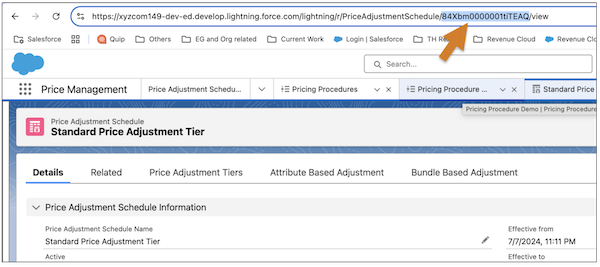
Default Value: Enter the bundle based adjustment ID from the browser.
You can locate the value of your variable by going to the associated record. For example, to locate a price adjustment schedule ID, open the price adjustment schedule record page. The price adjustment schedule ID is shown in the browser’s URL.
- Save your changes.
Add the Bundle-Based Price Element
-
Now, add the Pricing Setting element and map these variables.
- Input Variables
- Line Item: LineItem
- Output Variables
- Price Waterfall: price_water_fall
- Net Unit Price: NetUnitPrice.
- Subtotal: ItemNetTotalPrice
- Input Variables
-
Add the List Price element to fetch the base price of the product.
Under Lookup Table Details, select the Price Book Entries decision table and map these variables.
- Input Rule Variables
- Product: Product
- Price Book: PriceBooks
- Product Selling Model: ProductSellingModel
- Input Variables
- Quantity: LineItemQuantity
- Output Variables
- List Price: ListPrice
- Subtotal: ItemNetTotalPrice
- Input Rule Variables
-
To add the Bundle-Based Price element, search for and add the Bundle Based
Adjustment Entries decision table and map these variables.
- Input Rule Variables
- Price Adjustment Schedule: BundleBasedAdjustmentId
- Product Selling Model: ProductSellingModel
- Effective From: EffectiveFrom
- Effective To: EffectiveFrom
- Product: Product
- Parent Product: MainItemProduct
- Parent Product Selling Model: MainItemProductSellingModel
- Root Bundle: RootItemProduct
- Root Bundle Selling Model: RootItemProductSellingModel
- Input Variables
- Quantity: LineItemQuantity
- Input Unit Price: ListPrice
- Input Rule Variables
-
Click
 and select Include in Output.
- Finally, set your preferences to view pricing information, profile access, and rank information.
- Save your procedure.
-
Click Simulate to test your procedure. Enter the input values for
your laptop product and click Simulate again.
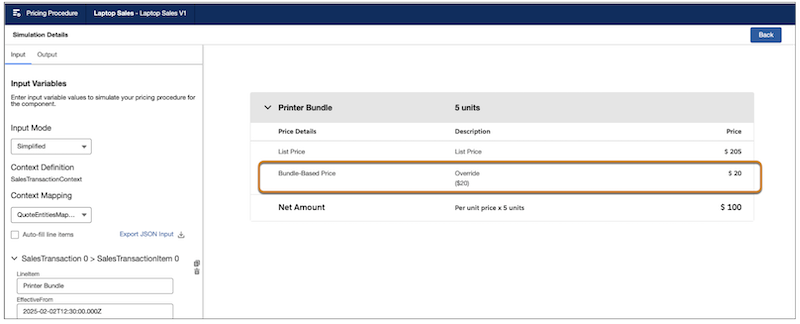
The price waterfall shows the bundle-based discounts used to calculate the final price of the printer bundle, confirming that your procedure is working as expected.
Did this article solve your issue?
Let us know so we can improve!
