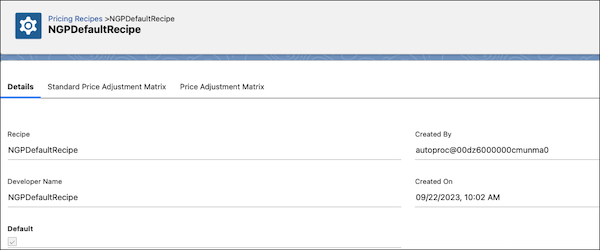
Pricing Recipes in Salesforce Pricing enable you to create and manage detailed pricing
strategies. These recipes associate data from selected objects with decision tables to develop
comprehensive pricing procedures. Understanding pricing recipes is crucial for successfully
leveraging Salesforce Pricing.
A pricing recipe groups decision tables that
serve as a data source for your pricing infrastructure. Pricing recipes also provide a
one-point configuration for how decision tables are used within procedures.
Salesforce
Pricing offers you flexible, data-model independent pricing, retrieving values from any
field. You can map a pricing recipe to a decision table, then use Dynamic Output Mapping to
define custom outputs for your elements. This provides precise control over pricing
calculations. We simplify setup with a predefined recipe and standard decision tables,
accelerating your procedure creation.
Select a Pricing Recipe for Your Salesforce Org Every Salesforce org requires a pricing recipe to define its pricing strategy. When Salesforce Pricing is activated, your org is automatically set up with a predefined recipe, though you can only have one active pricing recipe at a time. This recipe is essential for managing detailed pricing procedures.
Create a Pricing Recipe Learn how to create a custom pricing recipe to group and associate your custom decision tables, enabling precise control over pricing calculations in your Salesforce org. This task is essential when the predefined recipe doesn't meet your specific business needs.
Modify Price Adjustment Matrices Customize your pricing recipes by associating them with decision tables, allowing you to offer customers discounts based on specific conditions.
We use three kinds of cookies on our websites: required, functional, and advertising. You can choose whether functional and advertising cookies apply. Click on the different cookie categories to find out more about each category and to change the default settings.
Privacy Statement
Required Cookies
Always Active
Required cookies are necessary for basic website functionality. Some examples include: session cookies needed to transmit the website, authentication cookies, and security cookies.
Functional Cookies
Functional cookies enhance functions, performance, and services on the website. Some examples include: cookies used to analyze site traffic, cookies used for market research, and cookies used to display advertising that is not directed to a particular individual.
Advertising Cookies
Advertising cookies track activity across websites in order to understand a viewer’s interests, and direct them specific marketing. Some examples include: cookies used for remarketing, or interest-based advertising.