You can override the cardinality of product components and product classification
components that are at the second level and beyond in the product hierarchy. When you override
the local cardinality, you update the product component or product classification component
cardinality while maintaining a record of the original local cardinality. You can revert to the
original cardinality by restoring the default cardinality.
Required Editions
User Permissions
Needed
To override cardinality:
Manage Product Catalog
To use the structure tab:
ARC Access permission set
Note Overriding the cardinality overrides the cardinality for the product component or product
classification component in the context of the root product bundle. The cardinality of the
product component or product classification component remains the same in the context of
other product bundles.
Warning Overriding the local cardinality for a product that’s been added multiple times
in a bundle, overrides the local cardinality for every instance of the product throughout
the bundle.
From the Product Catalog Management app’s home page, click
Products.
From the Product list view page, click the bundled product that contains the product
component or product classification component whose cardinality you want to
override.
Navigate to the Structure tab.
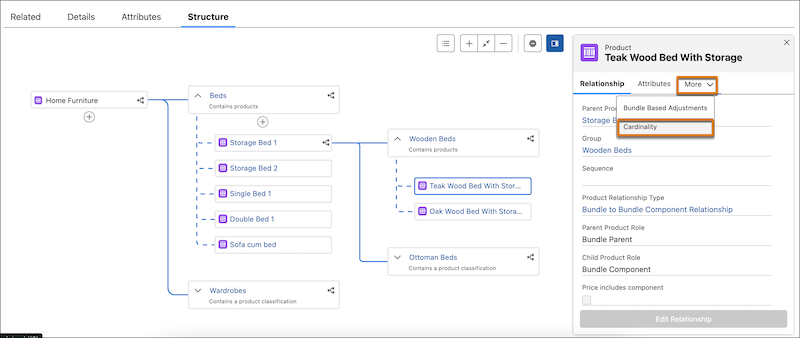
To override the product cardinality, click the product tile for a product at the second
level in the product hierarchy. To override the product classification cardinality, click
the product classification tile under a group at the second level in the product hierarchy
The first product in the bundle hierarchy is the root product. The
products, groups, and product classifications at the first level are the immediate child
components of the root product. You can edit the cardinality of products, groups, and product
classifications only at the first level. You can override the cardinality of products, groups,
and product classifications only at the second level and beyond.
In the right pane, click next to More, and click Cardinality.
Click Override.
Overriding the cardinality overrides the cardinality for the product component or product
classification component in the context of the product bundle. The original product
component or product classification component cardinality is retained and can be reverted
to if necessary.
Override the cardinality as necessary.
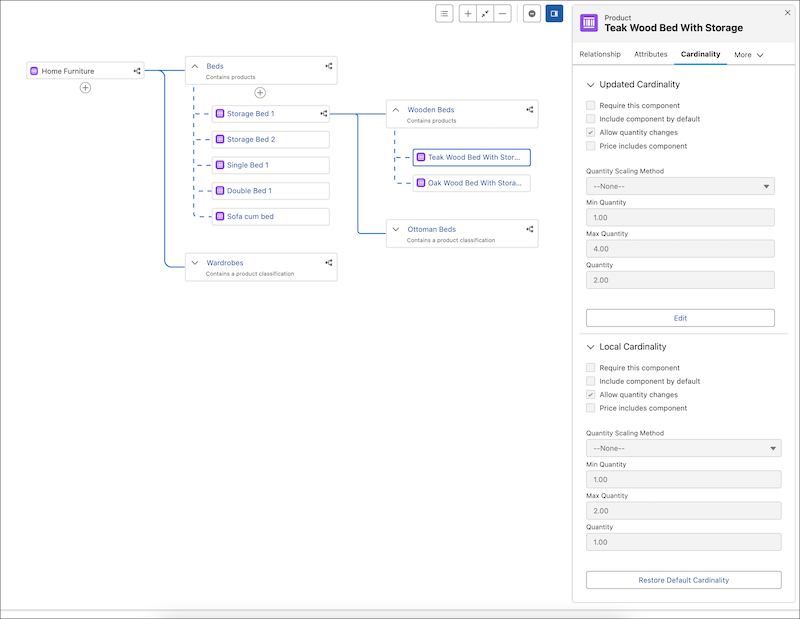
This example illustrates the local and updated cardinality for the product Teak
Wood Beds with Storage at the second level. The local cardinality was minimum quantity 1,
maximum quantity 2, and default quantity 1. The updated cardinality is minimum quantity 1,
maximum quantity 4, and the default quantity 2.
Save your changes.
The overridden cardinality appears in the right pane. You can edit the
overridden cardinality as necessary.
If you want to revert to the original product component or product classification component
cardinality, click Restore Default Cardinality. Restoring the default
cardinality deletes the overridden cardinality and restores the original product component
or product classification component cardinality.
Did this article solve your issue?
Let us know so we can improve!

Loading
Salesforce Help | Article
Cookie Consent Manager
General Information
Required Cookies
Functional Cookies
Advertising Cookies
General Information
We use three kinds of cookies on our websites: required, functional, and advertising. You can choose whether functional and advertising cookies apply. Click on the different cookie categories to find out more about each category and to change the default settings.
Privacy Statement
Required Cookies
Always Active
Required cookies are necessary for basic website functionality. Some examples include: session cookies needed to transmit the website, authentication cookies, and security cookies.
Functional Cookies
Functional cookies enhance functions, performance, and services on the website. Some examples include: cookies used to analyze site traffic, cookies used for market research, and cookies used to display advertising that is not directed to a particular individual.
Advertising Cookies
Advertising cookies track activity across websites in order to understand a viewer’s interests, and direct them specific marketing. Some examples include: cookies used for remarketing, or interest-based advertising.