Enable non-blocking behavior so that configurator users can change multiple attribute
and option values on a product asynchronously. The configuration page loads the changes without
waiting for the constraint engine to process each setting individually. After processing is
complete, the user can save the configuration.
Product Configuration Constraints Designer permission set
When you turn on Non Blocking Enabled, if the configurator user selects values for attributes
or options that violate rules on the constraint model, a warning message appears. For most
rules, the constraint engine overrides the user selection that violates a rule, and replaces it
with a valid value. For hide/disable rules, the value that the user selects overrides the
constraint engine, even if the value violates the rule.
From Setup, in the Quick Find box, enter Flow, and then select
Flows.
Open your product configurator flow.
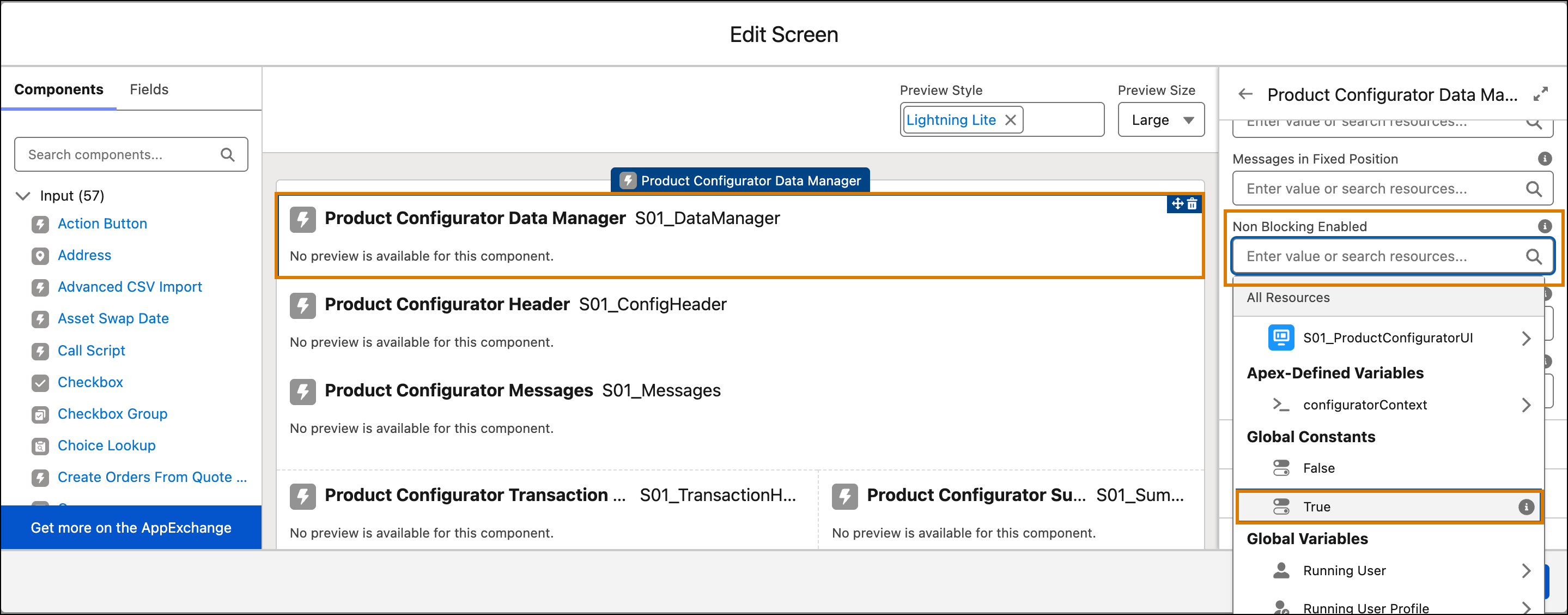
Edit the screen element and select the Product Configurator Data
Manager component.
To enable non-blocking behavior, for the Non Blocking Enabled attribute, select
{!$GlobalConstant.True}.
If you’re using the default Configurator flow, continue to step 6. For a custom flow,
repeat steps 3-4 to set the Non Blocking Enabled attribute for all the screen components.
When you've finished setting the attribute values, select
Done.
To activate the changes, select Save as New Version, then select
Activate.
Did this article solve your issue?
Let us know so we can improve!
Loading
Salesforce Help | Article
Cookie Consent Manager
Cookie Consent Manager
General Information
Required Cookies
Functional Cookies
Advertising Cookies
General Information
We use three kinds of cookies on our websites: required, functional, and advertising. You can choose whether functional and advertising cookies apply. Click on the different cookie categories to find out more about each category and to change the default settings.
Privacy Statement
Required Cookies
Always Active
Required cookies are necessary for basic website functionality. Some examples include: session cookies needed to transmit the website, authentication cookies, and security cookies.
Functional Cookies
Functional cookies enhance functions, performance, and services on the website. Some examples include: cookies used to analyze site traffic, cookies used for market research, and cookies used to display advertising that is not directed to a particular individual.
Advertising Cookies
Advertising cookies track activity across websites in order to understand a viewer’s interests, and direct them specific marketing. Some examples include: cookies used for remarketing, or interest-based advertising.