
You are here:
Maintain Data Integrity with Historical Order Migration
Generate assets from historical orders to establish a precise transactional lineage that ensures accurate calculations for future amendments, renewals, and cancellations. This approach uses standard Revenue Management flows to minimize manual record creation while maintaining stable, reconcilable data across the asset lifecycle.
Migrating the full order history chronologically to create a reliable foundation for complex lifecycle management and billing schedules regardless of your specific billing implementation.
Benefits of Generating Assets from Historical Orders
In Revenue Management, the historical lineage of an asset determines the calculation of future transactions. For example, an asset created from a single order for a quantity of 10 behaves differently than an asset created from an initial sale of 5 units followed by a positive amendment of 5 units. An accurate calculation of quantities and pricing for future negative amendments, cancellations, and renewals depends on this transactional history.
There are several key advantages to this approach.
- The system generates assets through standard Revenue Management flows.
- This approach minimizes the manual effort to edit Asset Action, Asset Action Source records, Asset State Period, and Asset Relationship records.
- Revenue Management uses built-in logic to calculate amendments, renewals, and cancellations.
- Future amendments remain stable and reconcilable.
Process Flow: Asset Generation from Historical Orders
Migrate data by recreating historical initial-sale orders and generating assets from those orders. This approach applies to initial-sale orders, subsequent amendments, and billing schedules.
The order-based strategy is the recommended path for all companies.
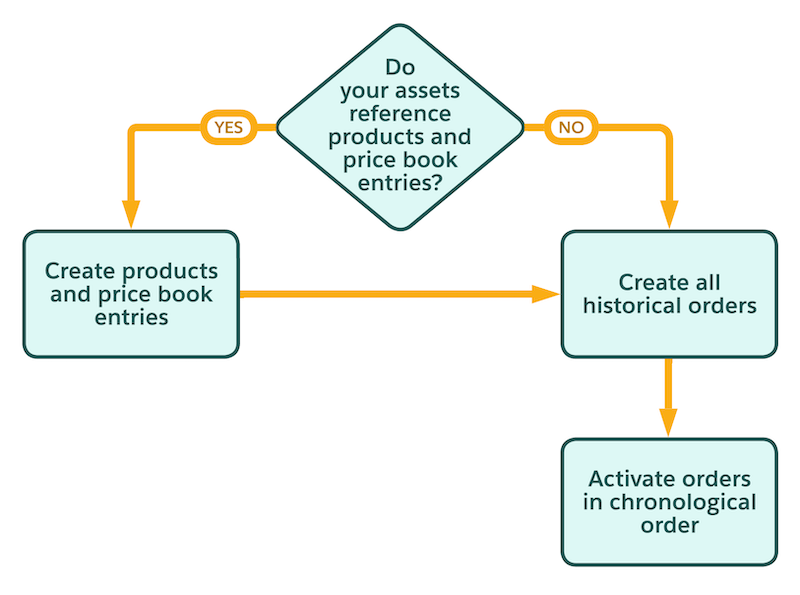
- If your asset data references Product and Price Book Entry records, create these records first.
- Create all historical orders, including initial-sale orders and all subsequent amendments.
- Activate orders in the chronological order that they occurred to make sure that assets and billing schedules are generated with the correct lineage.
