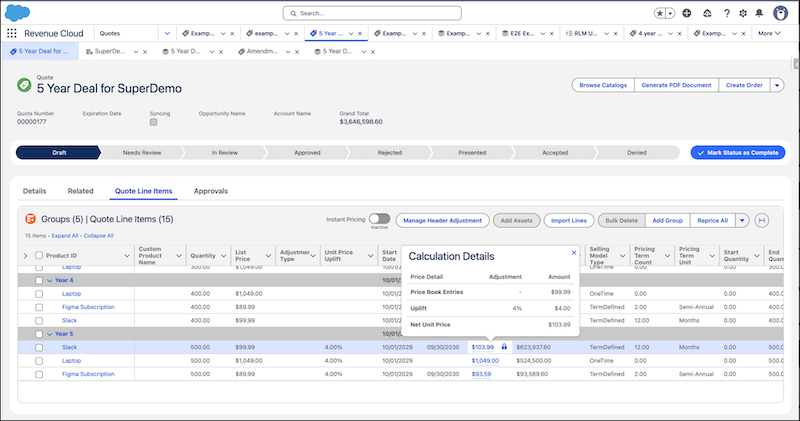
A ramp deal is a long-term sales agreement where price, quantity, and discounts vary
across defined time periods called segments. Instead of quoting a flat rate across the entire
contract, you break the deal into multiple segments—each with its own pricing, quantities, and
discounts. This gives your customers clear, upfront visibility into how costs evolve over the
life of the contract.
For example, a 3-year deal can have three annual segments: Year 1 with a 20% discount to
attract a new customer, Year 2 with a 10% discount, and Year 3 at full standard rate. Manage
each segment within a single transaction, so sales reps don't create separate quotes for each
phase of the deal.
When an order is assetized, Revenue Management(formerly Revenue Cloud) creates a single consolidated asset for all related line items of a
ramped product across segments. For ramped bundle products, a separate asset is created for
the root product and for each child product. This simplifies downstream asset management,
amendments, renewals, and cancellations.
When to Use Ramp Deals
Use ramp deals when:
You're negotiating multi-year contracts where pricing, quantities, or discounts change
over time.
Your customer wants to start up small and scale—for example, 100 licenses in Year 1, 200
in Year 2, and 500 in Year 3.
You want to offer a trial period at no additional cost before the main subscription
begins.
You're selling usage-based products and offer segment-specific rates or promotional
discounts in the early stages of a contract.
You need the full contract to appear in a single quote document rather than as separate
transactions.
Ramp Deal Structure for Groups Ramp deals contain time-bounded segments with distinct pricing, quantities, and discounts. The active structural mode dictates how you organize them.
We use three kinds of cookies on our websites: required, functional, and advertising. You can choose whether functional and advertising cookies apply. Click on the different cookie categories to find out more about each category and to change the default settings.
Privacy Statement
Required Cookies
Always Active
Required cookies are necessary for basic website functionality. Some examples include: session cookies needed to transmit the website, authentication cookies, and security cookies.
Functional Cookies
Functional cookies enhance functions, performance, and services on the website. Some examples include: cookies used to analyze site traffic, cookies used for market research, and cookies used to display advertising that is not directed to a particular individual.
Advertising Cookies
Advertising cookies track activity across websites in order to understand a viewer’s interests, and direct them specific marketing. Some examples include: cookies used for remarketing, or interest-based advertising.