The CRM Analytics Prediction add-on uses Health Cloud records to create an appointment
prediction model. The data model can use records up to 730 days old. To keep the model up to date,
run a dataflow to refresh the model with new records.
Required Editions
Available in: Lightning Experience
Available in: Enterprise and Unlimited Editions with Health
Cloud
User Permissions Needed
To use Einstein Discovery
CRM Analytics for Healthcare
From the App Launcher, find and select Analytics Studio.
In the navigation tree, click Data Manager, then click
Manage Dataflows.
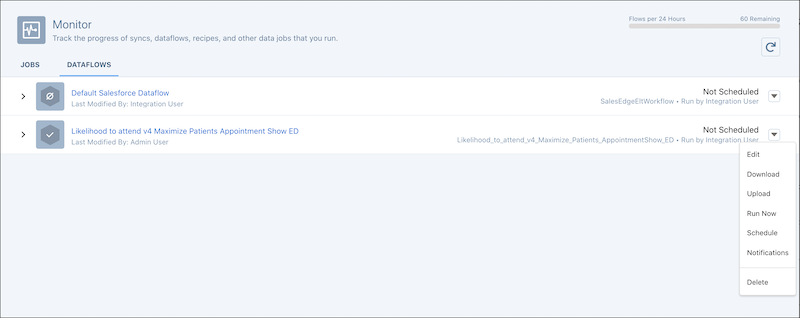
Click the DATAFLOWS tab.
Identify the dataflow for your prediction model.
For example, Likelihood to Attend v4 Maximize Patients Appointment Show ED. Or something
named more generic.
Click the dropdown menu for the dataflow and select one of these options.
Run Now: To source new records from Health Cloud right away.
Schedule: To run the dataflow later. To use time-based synchronization, specify your
preferences using the Schedule by and Start at
options. Otherwise, select Event-based and choose your event criteria,
such as Salesforce local connection syncs.
Save your changes.
Did this article solve your issue?
Let us know so we can improve!
Loading
Salesforce Help | Article
Cookie Consent Manager
General Information
Required Cookies
Functional Cookies
Advertising Cookies
General Information
We use three kinds of cookies on our websites: required, functional, and advertising. You can choose whether functional and advertising cookies apply. Click on the different cookie categories to find out more about each category and to change the default settings.
Privacy Statement
Required Cookies
Always Active
Required cookies are necessary for basic website functionality. Some examples include: session cookies needed to transmit the website, authentication cookies, and security cookies.
Functional Cookies
Functional cookies enhance functions, performance, and services on the website. Some examples include: cookies used to analyze site traffic, cookies used for market research, and cookies used to display advertising that is not directed to a particular individual.
Advertising Cookies
Advertising cookies track activity across websites in order to understand a viewer’s interests, and direct them specific marketing. Some examples include: cookies used for remarketing, or interest-based advertising.