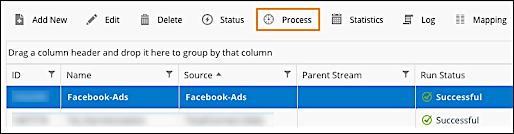
Re-process is a common action that updates the data within a selected data stream. The
most popular use for Re-process is when a dataset changes on the platform’s side, such as
Facebook, and the user wants to pull the update back to Marketing Cloud Intelligence. This action proactively pulls
the new data instead of waiting for a scheduled update to take place (if applicable).
Required Editions
User Permissions Needed
To edit a data stream:
Admin
Navigate to the Connect & Mix tab.
Expand Data Streams, and then expand Data Streams
List.
Select the data stream from the list, and from the top toolbar, click
Process to open the Process Data dialog.
Select the relevant date ranges for the data that you’re reprocessing.
To process data for days that the data steam failed, select Process Data Stream
Failed Days.
Click Process. New data is retrieved for the specified date range,
including failed retrievals.
Did this article solve your issue?
Let us know so we can improve!
Loading
Salesforce Help | Article
Cookie Consent Manager
Cookie Consent Manager
General Information
Required Cookies
Functional Cookies
Advertising Cookies
General Information
We use three kinds of cookies on our websites: required, functional, and advertising. You can choose whether functional and advertising cookies apply. Click on the different cookie categories to find out more about each category and to change the default settings.
Privacy Statement
Required Cookies
Always Active
Required cookies are necessary for basic website functionality. Some examples include: session cookies needed to transmit the website, authentication cookies, and security cookies.
Functional Cookies
Functional cookies enhance functions, performance, and services on the website. Some examples include: cookies used to analyze site traffic, cookies used for market research, and cookies used to display advertising that is not directed to a particular individual.
Advertising Cookies
Advertising cookies track activity across websites in order to understand a viewer’s interests, and direct them specific marketing. Some examples include: cookies used for remarketing, or interest-based advertising.