Control How Users Can Change Email Template Content
Email templates that you create in Account Engagement are editable by default. If you
want users to edit only parts of a template, you can define which elements are editable. When you
define at least one element as editable, the default behavior changes and any element that you
don’t define as editable is locked.
Required Editions
Available in: All Account
Engagement Editions
User Permissions Needed
To edit email templates:
Account Engagement Administrator or Marketing
role
Editing restrictions aren’t applied to emails created using the Send Account Engagement Email
button.
Open the Email Templates page.
In Account Engagement, select Marketing | Emails | Templates.
In the Lightning app, select Account Engagement Email and
then Templates.
Create or edit an email template.
On the Building tab, click HTML to edit the source code.
Insert an attribute for each element to define what users can do.
pardot-region lets users edit the content of an
element.
pardot-repeatable lets users copy or move the
element.
pardot-removable lets users remove the
element
To combine capabilities, nest different attributes. For example, to make a section
removable and editable, use both pardot-removable and
pardot-region.
<td width="200">
	<div pardot-removable="sidebar-1">
	<div pardot-region>
	<h1>Title</h1>
	A paragraph of text
		<a href="#">Read More</a>
	</div>
	</div>
	</td>
When combining content regions, you can only nest different attributes.
To make the template available to users, click Publish to
Template.
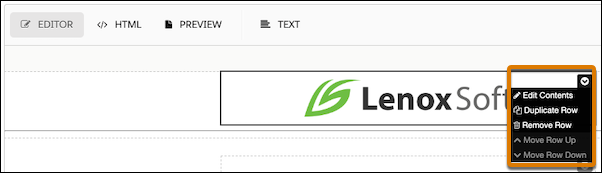
When a user applies the template, a dropdown menu appears in the corner of each editable
section with the options available for that element.
We use three kinds of cookies on our websites: required, functional, and advertising. You can choose whether functional and advertising cookies apply. Click on the different cookie categories to find out more about each category and to change the default settings.
Privacy Statement
Required Cookies
Always Active
Required cookies are necessary for basic website functionality. Some examples include: session cookies needed to transmit the website, authentication cookies, and security cookies.
Functional Cookies
Functional cookies enhance functions, performance, and services on the website. Some examples include: cookies used to analyze site traffic, cookies used for market research, and cookies used to display advertising that is not directed to a particular individual.
Advertising Cookies
Advertising cookies track activity across websites in order to understand a viewer’s interests, and direct them specific marketing. Some examples include: cookies used for remarketing, or interest-based advertising.