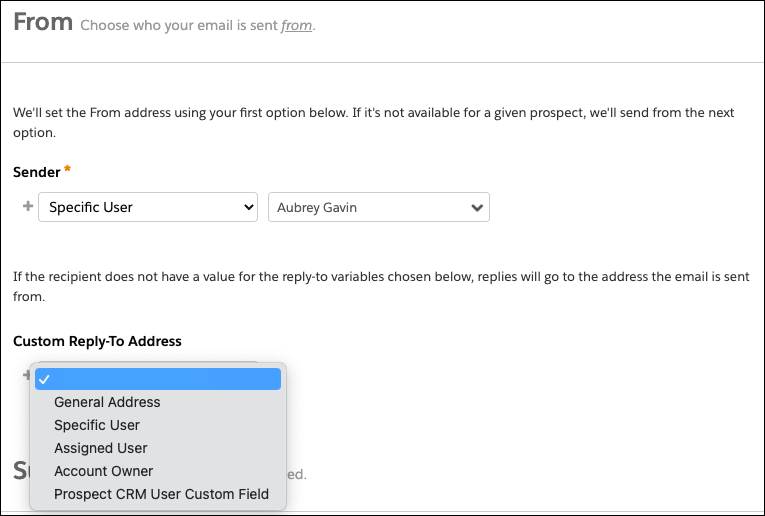
You can configure a sender and a custom reply-to address for your classic email in
Account Engagement. The sender is the name and email address that appears in a prospect’s inbox.
Optionally, you can specify a different email address to receive replies from your prospects. If
you don’t specify a reply-to email address, Account Engagement uses the sender email
address.
Required Editions
Available in: All Account
Engagement Editions
The options for choosing a sender and a reply-to address are the same. Only the Sender
address is required.
The last sender in a sender hierarchy must be either a Specific User with a verified email
domain or General User with a verified email domain. If the Specific User or General User
sender email address doesn't include a verified email domain, an error occurs in the
editor, preventing you from saving or sending the email or email template.
At the time of the email send, the sender hierachy is reviewed, starting at the top. The
first sender found in the hierarchy that has an email address with a verified email domain
is considered valid, and the email sends from that email address.
If no senders in the hierarchy are found to be valid, the email doesn’t send, resulting in
a failed email send. You can learn more about failed email sends here.
General User
Enter the sender’s name and email address. Avoid role-based addresses that are often
caught by spam filters. For example, don’t use sales@ or
admin@ addresses.
Specific User
Select an Account Engagement user from the dropdown.
Assigned User
The email uses the address of the user that the prospect is assigned to.
Account Owner
The email uses the address of the user that owns the prospect’s account. The current
Account Owner only displays in Account Engagement after it’s synced
from Salesforce.
Prospect CRM User Custom Field
Select a CRM User custom field from the dropdown. The email uses the address of the
CRM User displayed on the prospect record. You can learn more about using CRM User
custom fields here.
Did this article solve your issue?
Let us know so we can improve!
Loading
Salesforce Help | Article
Cookie Consent Manager
Cookie Consent Manager
General Information
Required Cookies
Functional Cookies
Advertising Cookies
General Information
We use three kinds of cookies on our websites: required, functional, and advertising. You can choose whether functional and advertising cookies apply. Click on the different cookie categories to find out more about each category and to change the default settings.
Privacy Statement
Required Cookies
Always Active
Required cookies are necessary for basic website functionality. Some examples include: session cookies needed to transmit the website, authentication cookies, and security cookies.
Functional Cookies
Functional cookies enhance functions, performance, and services on the website. Some examples include: cookies used to analyze site traffic, cookies used for market research, and cookies used to display advertising that is not directed to a particular individual.
Advertising Cookies
Advertising cookies track activity across websites in order to understand a viewer’s interests, and direct them specific marketing. Some examples include: cookies used for remarketing, or interest-based advertising.