Occasionally, a prospect is on several lists that you use to feed engagement programs.
To make sure that the prospect receives only the most important emails, use suppression lists to
keep them from going through lower-priority programs.
Required Editions
Available in: All Account
Engagement Editions
Let’s say you have a prospect, Pat Smith, who is on 3 different lists: List A, List B, and
List C. You want to send 3 programs: Program 1, Program 2, Program 3. You don't want your
overlapping prospects, like Pat Smith, to go through more than one program at a time. Use lists
to prioritize your programs and suppress overlapping prospects from receiving the lower-priority
program emails.
Program Setup
Let's say that Program 1 is your highest-priority
program, Program 2 is less important than Program 1, and Program 3 is the least important. You
want any prospects that are on List A and List B or List C to receive only Program 1 emails.
This table gives an example of how to set up your recipient and suppression lists:
List
Program 1
Program 2
Program 3
Recipient List
List A
List B
List C
Suppression List
None
List A
List A and List B
In the table, prospects that are on List A are suppressed from receiving Program 2 and
Program 3 emails, even if they are on List B or C. Prospects that are on List B and C are
suppressed from receiving Program 3 emails.
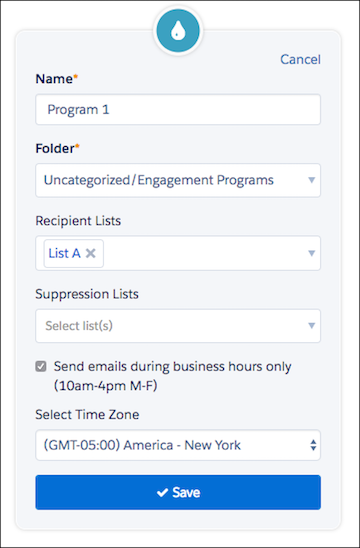
Program 1 uses List A as a recipient list, and
doesn’t have any suppression lists.
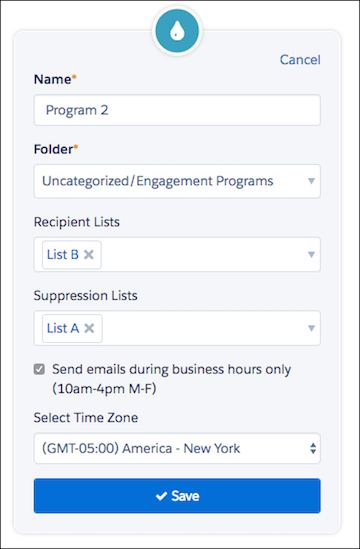
Program 2 uses List B as a recipient list, and uses List A as a suppression list, which
keeps prospects on List A from receiving emails from this program.
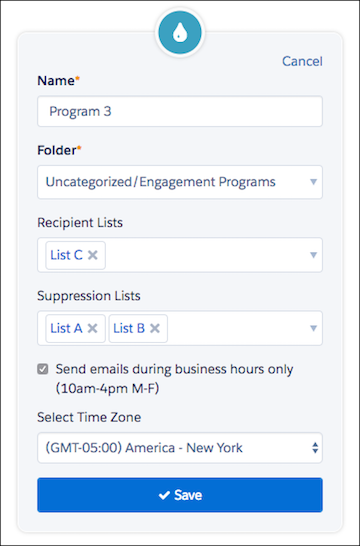
Program 3 uses List C as a recipient list, and uses both List A and List B as
suppression lists, which prevents prospects on List A or B from receiving emails from this
program.
Did this article solve your issue?
Let us know so we can improve!
Loading
Salesforce Help | Article
Cookie Consent Manager
Cookie Consent Manager
General Information
Required Cookies
Functional Cookies
Advertising Cookies
General Information
We use three kinds of cookies on our websites: required, functional, and advertising. You can choose whether functional and advertising cookies apply. Click on the different cookie categories to find out more about each category and to change the default settings.
Privacy Statement
Required Cookies
Always Active
Required cookies are necessary for basic website functionality. Some examples include: session cookies needed to transmit the website, authentication cookies, and security cookies.
Functional Cookies
Functional cookies enhance functions, performance, and services on the website. Some examples include: cookies used to analyze site traffic, cookies used for market research, and cookies used to display advertising that is not directed to a particular individual.
Advertising Cookies
Advertising cookies track activity across websites in order to understand a viewer’s interests, and direct them specific marketing. Some examples include: cookies used for remarketing, or interest-based advertising.