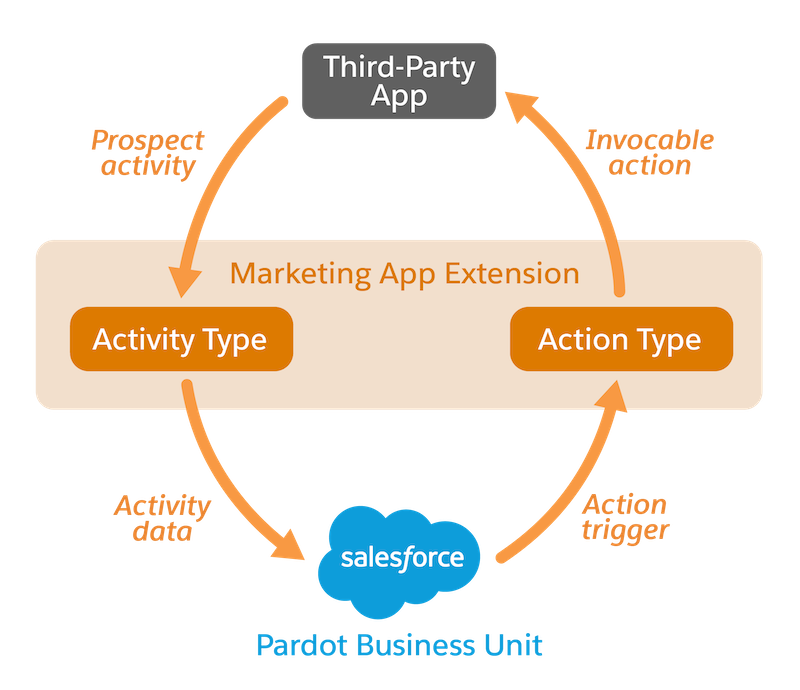
A marketing app extension represents a third-party app that you use with prospects. You
can add activity types or action types to an extension to capture external prospect activity or
make external actions available to use in Engagement Studio programs.
Required Editions
Available in: Account Engagement Plus,
Advanced, and Premium
Editions
The marketing app extension acts as a category for activity types and action types,
each representing a simple integration. An activity type receives data from an external system,
while the action type sends data to an external system.
You create the extension in Marketing Setup and then add and define the activity types
and action types. Work with your developer to complete the integration for each activity type
and action type. After your integrations are complete and the activity types and action types
are active, you can use them in automations.
Activity Types
Add an activity type to a marketing app extension to define the kind of external prospect
activity that you want to capture. After you add an activity type to an extension, your
developer can help you complete the integration via the API. For example, if “Attend Webinar” is
the activity type, the activity type record receives prospect activity data each time a prospect
attends the webinar specified in the integration. You can use external activity data in
automation rules, segmentation rules, and Engagement Studio programs. External activity data
appears on the prospect list table and on the Activities tab on an individual prospect
record.
Action Types
Add an action type to enable your team to trigger that action on prospects externally, such as
registering them for a webinar. An action type requires an invocable action. You can use a
supported standard invocable action available in your org, install one from AppExchange, or work
with your developer to create a custom action.
When you create an action type, the record generates a schema and parameters. The schema
defines how the action step displays in Engagement Studio and how the action executes. Work with
your developer to edit the schema fields to meet your needs. Here’s what you can do:
Define which fields appear on an external action step in Engagement Studio.
Map schema fields to HML merge fields so that they automatically populate when the step
executes and data is passed to your external system.
Set default values for empty fields.
After you finish setup for an action, you can use it in Engagement Studio programs.
Did this article solve your issue?
Let us know so we can improve!
Loading
Salesforce Help | Article
Cookie Consent Manager
Cookie Consent Manager
General Information
Required Cookies
Functional Cookies
Advertising Cookies
General Information
We use three kinds of cookies on our websites: required, functional, and advertising. You can choose whether functional and advertising cookies apply. Click on the different cookie categories to find out more about each category and to change the default settings.
Privacy Statement
Required Cookies
Always Active
Required cookies are necessary for basic website functionality. Some examples include: session cookies needed to transmit the website, authentication cookies, and security cookies.
Functional Cookies
Functional cookies enhance functions, performance, and services on the website. Some examples include: cookies used to analyze site traffic, cookies used for market research, and cookies used to display advertising that is not directed to a particular individual.
Advertising Cookies
Advertising cookies track activity across websites in order to understand a viewer’s interests, and direct them specific marketing. Some examples include: cookies used for remarketing, or interest-based advertising.