You are here:
Send an Email from a Flow Example
This example uses the Send Email action to send an email to a new contact. Your sales reps might forget to email new customers to welcome them, so you want to email the new contacts automatically with a flow.
Required Editions
| View supported editions. |
| User Permissions Needed | |
|---|---|
| To open, edit, create, activate or deactivate a flow using all flow types, elements, and features available in Flow Builder, including Einstein and Agentforce for Flow: | Manage Flow |
| To create a contact: |
|

Important To send email from Salesforce, the Send
Email action in Salesforce Flow requires domain-level and user-level email verification.
Email delivery fails if either the user's email address or the email-sending domain is
unverified. See Requirements to Send Email from Salesforce.

Note If you're following along in an existing flow, make sure the Send Email action
version is set to 1.0.1.
View this video in a separate tab.
Create the flow that sends an email to the new contact.
-
Open the Flows list view.
- From the Automation app, select the Flows tab.
- From the Flows tab in any Lightning app, click the actions menu and select Open Flow.
- From Setup, in the Quick Find box, enter Flows, and then select Flows.
Note that the Automation app and Flows tab options don't require Setup access. -
Create a record-triggered flow.
- From the Automation app, click New | Triggered | Record-Triggered Flow.
- From Setup, click New Flow | Triggered | Record-Triggered Flow.
-
Configure the Start element.
-
For Object, click Contact.
Contact is selected because that's the type of record that triggers the flow when it's created.
-
For Trigger the Flow When, select A record is created.
A record is created is selected because we want the flow triggered each time a contact record is created.
-
For Condition Requirements, select None.
Condition requirements narrow down when to trigger the flow. For example, you can set a condition to trigger the flow only for new contacts that live in California. But for this example, because you want the flow triggered with every new contact, no conditions are needed.
- Use the default values for the other fields.
-
For Object, click Contact.
-
Add and configure an Action element. The action element is used to send the email.
-
Click
 , and select Action.
A list of available actions opens.
, and select Action.
A list of available actions opens. -
In the search bar, enter Send Email, and then click
Send Email.
For more information about the Send Email action, see Flow Core Action: Send Email.
- For Label, enter Send New Contact Email and use the default API name, Send_New_Contact_Email.
- For Recipient Addresses, click Triggering Contact, and then click Email.
- Click Compose Email Content.
- For Subject, enter the text Welcome aboard!.
- For Body, enter the rich text Hello!. Then, to insert the Contact's First Name, click Insert a resource... | Triggering Contact | First Name.
- Enter the remaining email body content as Welcome to the family. Thank you for supporting our business. Sincerely, All of Us at Acme Corp.
- For the Rich-Text-Formatted Body value, click True.
- Use the default values for the other fields.
-
Click
- Save and name the flow.
- To make sure that the flow works as expected, debug and test it by using different scenarios.
- To start sending emails, activate the flow.
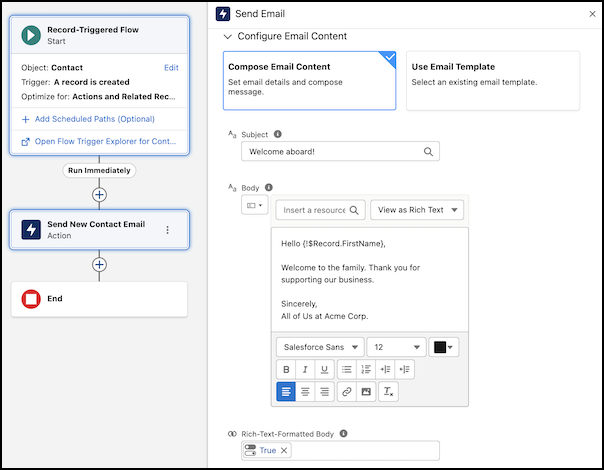
The flow sends an email to contacts that are created.
Important After migrating flows, always review and reconfigure
the Send Email action to reference the new record IDs in the target Salesforce org. This
step is crucial to avoid broken references and to make sure that email delivery functions
correctly.
Did this article solve your issue?
Let us know so we can improve!
