Several types of flows automate tasks in the background. As a result, if an error
occurs, it can be some time before you notice that anything is wrong with your business process.
See which flows need attention at a glance with the Element Error Rate field. This field shows a
green success icon for healthy flows and a yellow warning icon for unhealthy flows. Learn how
Salesforce calculates the error rate and which metrics it uses in the calculation.
The element error rate is the percentage of flow elements used during the last flow
occurrence that resulted in errors. Flows with a 0% error rate have no errors and show a
green icon. Flows with any error rate from 1% to 100% show a yellow icon indicating a need
for investigation. This field is visible on the standard Flows list view and on individual
flow record pages.
Element Runs
The number of elements activated during the last flow occurrence, which isn't the same as
the total number of elements in the flow. To see the number of activated elements, hover
over the Element Error Rate field or add the Element Runs field to a list view.
Element Errors
The number of elements that resulted in errors during the last flow occurrence. To see the
number, hover over the Element Error Rate field or add the Element Errors field to a list
view.
Flow Occurrences
Each time a flow runs, it creates a flow occurrence. Depending on the flow, a flow
occurrence can consist of several flow interviews. A flow that runs weekly on 50 records has
one flow occurrence and 50 flow interviews each week.
Example of How the Element Error Rate Is Calculated
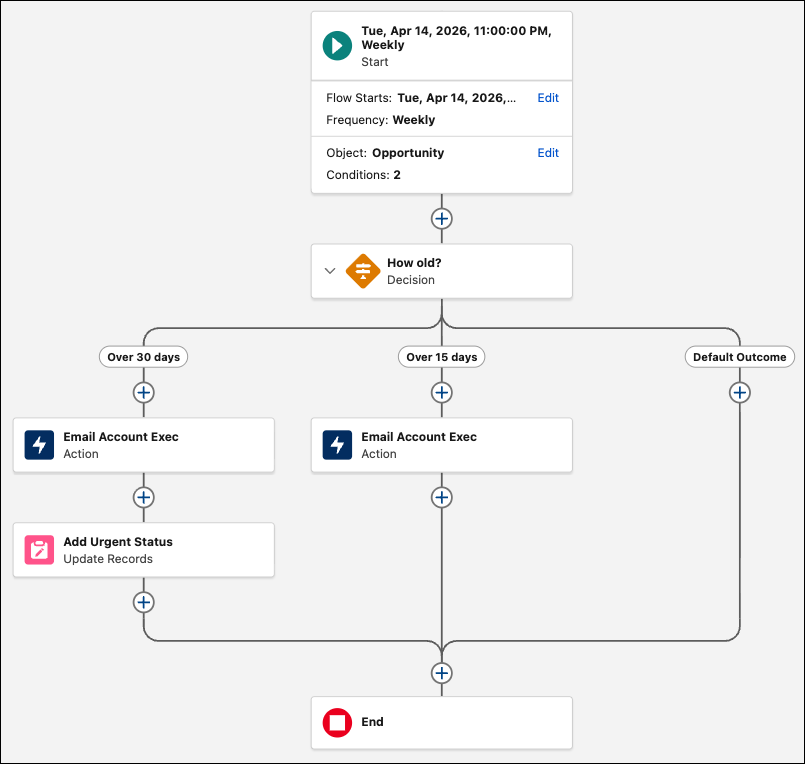
This flow has a Decision element that splits three possible ways.
If this flow goes along the Over 30 days path, it runs the Decision, Action, and Update
Records elements for a total of three elements. On the Over 15 days path, it runs two
elements, and on the Default Outcome path, it runs only one element.
Suppose that this flow runs the Over 30 days path, but encounters an error during the
Update Records element. The flow now has one element error and three elements run, causing
the element error rate to be 1/3 or 33%.
The flow runs weekly on any record that is still active, and on a given run, the flow finds
100 eligible records. Of the flow interviews created for those records:
15 run the Over 30 days path, 5 of which encounter an error at the Update Records
element, totaling 45 elements run and five errors.
45 run the Over 15 days path, 10 of which encounter an error at the Action element,
totaling 30 elements run and 10 errors.
40 run the Default Outcome path, but there are 5 that encounter an error at the Decision
element, totaling 40 elements run and five errors.
In this example, the element error rate for the entire flow occurrence is 115 elements run
with 20 errors, or 17%. This percentage is the number shown in the Element Error Rate field.
Did this article solve your issue?
Let us know so we can improve!

Loading
Salesforce Help | Article
Cookie Consent Manager
General Information
Required Cookies
Functional Cookies
Advertising Cookies
General Information
We use three kinds of cookies on our websites: required, functional, and advertising. You can choose whether functional and advertising cookies apply. Click on the different cookie categories to find out more about each category and to change the default settings.
Privacy Statement
Required Cookies
Always Active
Required cookies are necessary for basic website functionality. Some examples include: session cookies needed to transmit the website, authentication cookies, and security cookies.
Functional Cookies
Functional cookies enhance functions, performance, and services on the website. Some examples include: cookies used to analyze site traffic, cookies used for market research, and cookies used to display advertising that is not directed to a particular individual.
Advertising Cookies
Advertising cookies track activity across websites in order to understand a viewer’s interests, and direct them specific marketing. Some examples include: cookies used for remarketing, or interest-based advertising.