As a best practice, we recommend configuring the fault connectors in your flow so that
you always receive an email when a flow fails. In the email, include the current values of all
your flow’s resources. The resource values can give you insight into why the flow
failed.
To open, edit, create, activate or
deactivate a flow using all flow types, elements, and features available in Flow
Builder, including Einstein and Agentforce for Flow:
Manage Flow
Note You don't need to be an admin to have the Manage Flow permission.
Ask your admin to add it to your profile or permission set.
Important To send email from Salesforce, the Send
Email action in Salesforce Flow requires domain-level and user-level email verification.
Email delivery fails if either the user's email address or the email-sending domain is
unverified. See Requirements to Send Email from Salesforce.
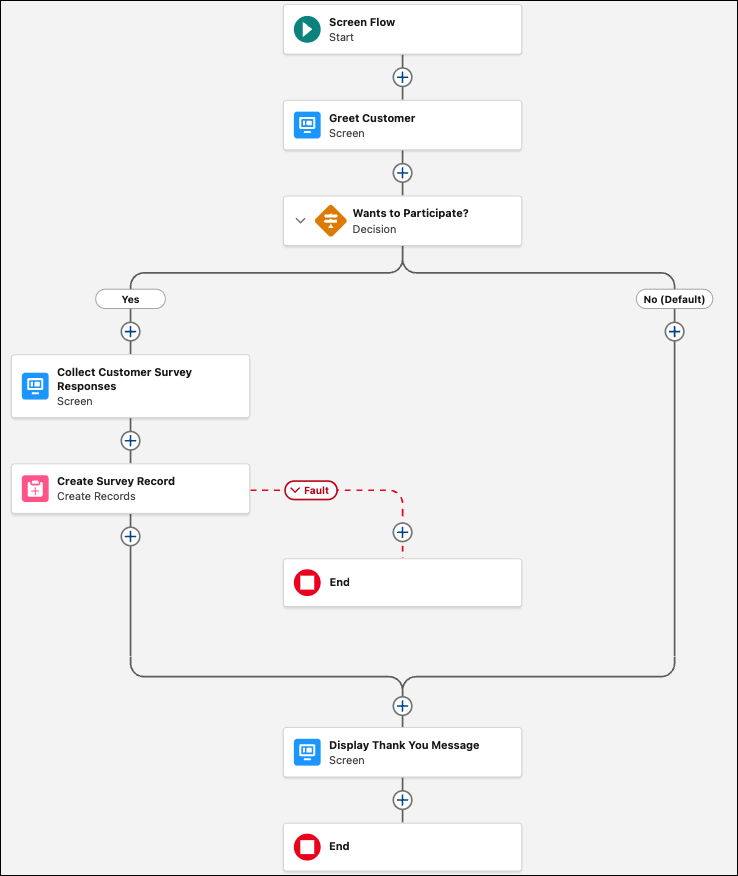
Add a fault path to an element in your flow.
In this example, we added a fault path to the Create Survey
Records element.
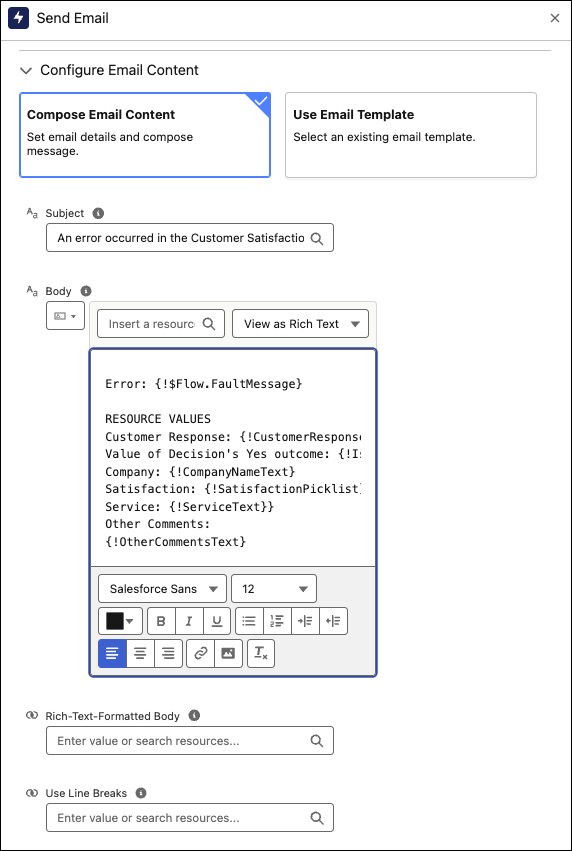
Add a Send Email action to the fault path in the flow.
For Recipient Address List, enter your email address.
Click Compose Email Content.
For Subject, enter a string to use as the email
subject.
For Body, enter the email body content.
In this example, we have used the following email body content.
Error: {!$Flow.FaultMessage}

RESOURCE VALUES
Customer Response: {!CustomerResponseRadioButtons}
Value of Decision's Yes outcome: {!IsWantsToParticipate}
Company: {!CompanyNameText}
Satisfaction: {!SatisfactionPicklist}
Service: {!ServiceText}}
Other Comments:
{!OtherCommentsText}
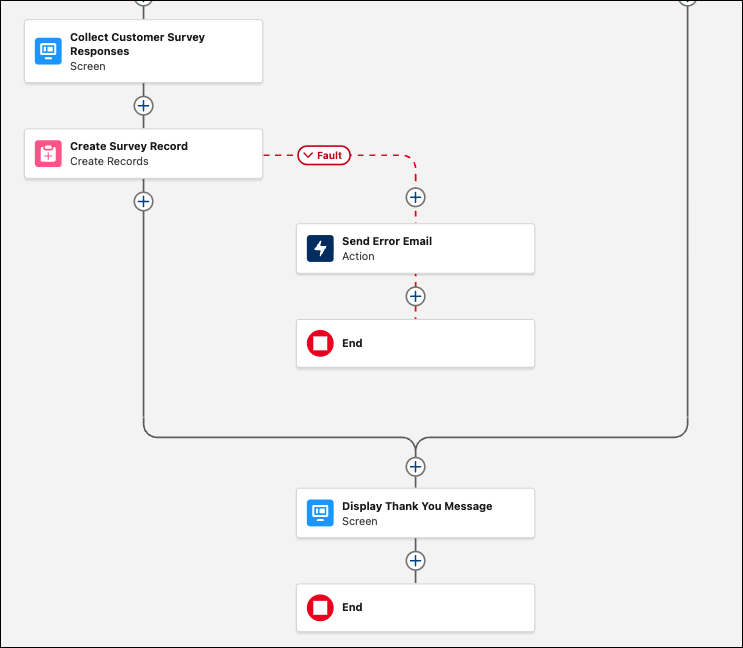
The fault path now connects to the Send Error Email element.
From every other element that can fail, add a fault path to the Send Error Email
element.
In this example, Create Survey Record is the only element that supports fault
paths.
We use three kinds of cookies on our websites: required, functional, and advertising. You can choose whether functional and advertising cookies apply. Click on the different cookie categories to find out more about each category and to change the default settings.
Privacy Statement
Required Cookies
Always Active
Required cookies are necessary for basic website functionality. Some examples include: session cookies needed to transmit the website, authentication cookies, and security cookies.
Functional Cookies
Functional cookies enhance functions, performance, and services on the website. Some examples include: cookies used to analyze site traffic, cookies used for market research, and cookies used to display advertising that is not directed to a particular individual.
Advertising Cookies
Advertising cookies track activity across websites in order to understand a viewer’s interests, and direct them specific marketing. Some examples include: cookies used for remarketing, or interest-based advertising.