Move Processes and Workflows to Flow Builder with the Migrate to Flow Tool
Use the Migrate to Flow tool to convert your Process Builder processes and workflow
rules into Flow Builder, including scheduled actions. The tool also supports partial migration
of processes for most actions.
To open, edit, create, activate or
deactivate a flow using all flow types, elements, and features available in Flow
Builder, including Einstein and Agentforce for Flow:
Manage Flow
To create, change, activate, or deactivate workflow rules and actions:
Customize Application
To create, edit, or view processes:
Manage Flow
AND
View All Data
To activate or deactivate processes:
Manage Flow
AND
View All Data
AND
Customize
Application
Before moving your new flows to production, start with migrating and testing in a
sandbox environment.
From Setup, in the Quick Find box, enter Migrate to Flow, and
then select Migrate to Flow.
Select the process that you want to convert to a flow.
Click Migrate to Flow.
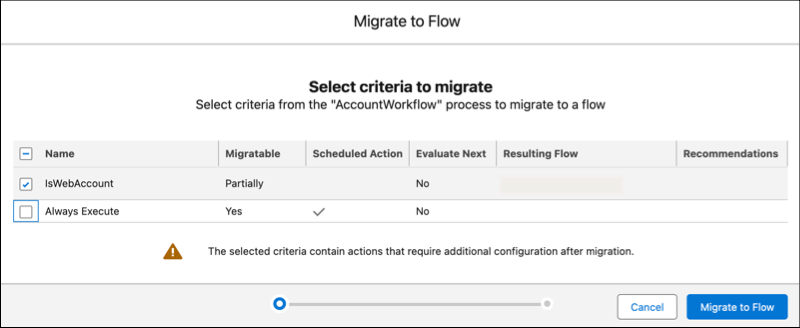
Select the criteria that you want to migrate.
If it’s a process, the Migratable column indicates whether you can fully or partially
migrate the process.
Click Migrate to Flow.
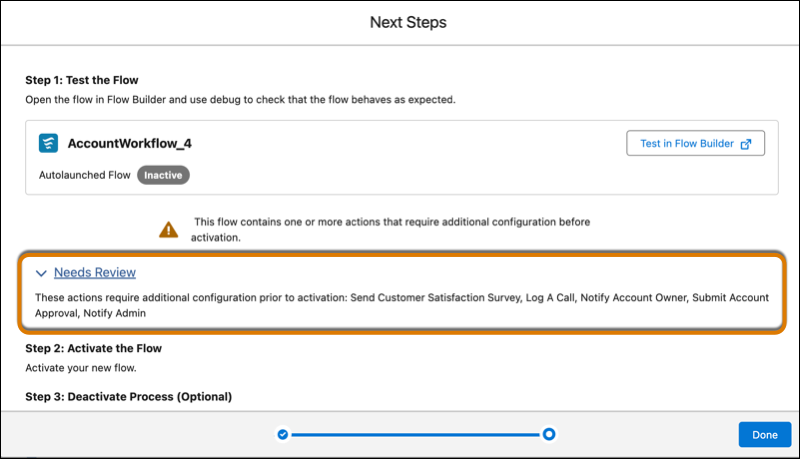
If this is a partial migration of a process, click Needs Review
when the migration is complete to see the list of actions that require additional
configuration.
After you migrate a process or workflow rule, test the flow in Flow Builder.
If everything works as expected, activate the flow.
Deactivate the process or workflow rule you migrated to Flow Builder.
Did this article solve your issue?
Let us know so we can improve!
Loading
Salesforce Help | Article
Cookie Consent Manager
Cookie Consent Manager
General Information
Required Cookies
Functional Cookies
Advertising Cookies
General Information
We use three kinds of cookies on our websites: required, functional, and advertising. You can choose whether functional and advertising cookies apply. Click on the different cookie categories to find out more about each category and to change the default settings.
Privacy Statement
Required Cookies
Always Active
Required cookies are necessary for basic website functionality. Some examples include: session cookies needed to transmit the website, authentication cookies, and security cookies.
Functional Cookies
Functional cookies enhance functions, performance, and services on the website. Some examples include: cookies used to analyze site traffic, cookies used for market research, and cookies used to display advertising that is not directed to a particular individual.
Advertising Cookies
Advertising cookies track activity across websites in order to understand a viewer’s interests, and direct them specific marketing. Some examples include: cookies used for remarketing, or interest-based advertising.