Look Up Licensing Event History in Setup Audit Trail
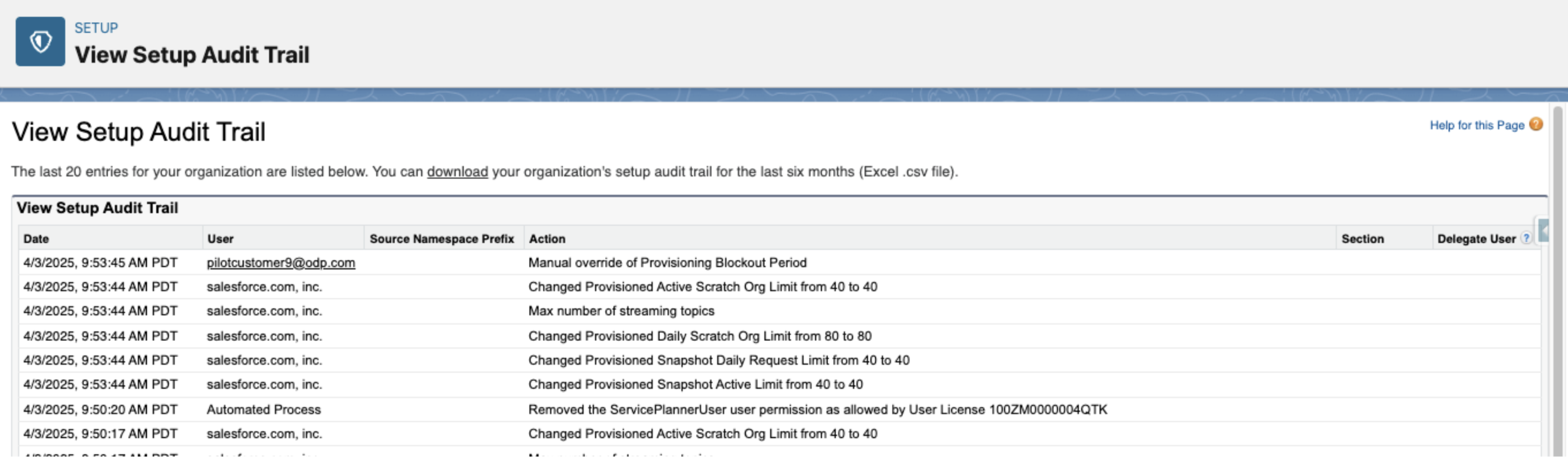
When a licensing event is triggered for your org, a corresponding entry is added to the
Setup Audit Trail page. With Licensing Events enabled, standard entitlement delivery continues as
usual, but an additional row is recorded for any license application—whether manual or occurring
outside designated blockout periods.
Required Editions
Available in: Lightning Experience
Available in: Enterprise, Performance,
and Unlimited Editions
For example, to view contracts, a user needs the Read permission on contracts. To assign a
given permission to a user, that user’s license (or licenses) must support the permission.
Multiple licenses can support a single permission.
In Setup, find and select Setup Audit Trail.
After a licensing request is delivered, an entry appears in the Setup Audit Trail
table.
If a licensing request is applied manually (override) or outside the blockout period, a
separate row logs the exact date and time of the event.
Did this article solve your issue?
Let us know so we can improve!
Loading
Salesforce Help | Article
Cookie Consent Manager
Cookie Consent Manager
General Information
Required Cookies
Functional Cookies
Advertising Cookies
General Information
We use three kinds of cookies on our websites: required, functional, and advertising. You can choose whether functional and advertising cookies apply. Click on the different cookie categories to find out more about each category and to change the default settings.
Privacy Statement
Required Cookies
Always Active
Required cookies are necessary for basic website functionality. Some examples include: session cookies needed to transmit the website, authentication cookies, and security cookies.
Functional Cookies
Functional cookies enhance functions, performance, and services on the website. Some examples include: cookies used to analyze site traffic, cookies used for market research, and cookies used to display advertising that is not directed to a particular individual.
Advertising Cookies
Advertising cookies track activity across websites in order to understand a viewer’s interests, and direct them specific marketing. Some examples include: cookies used for remarketing, or interest-based advertising.