Salesforce Billing must retain a copy of all credit notes for legal and accounting
purposes. To fix an error on a posted credit note, create a debit note of equal value and allocate
it to each line of the original credit note. The allocation reduces the erroneous credit note’s
balance to zero. You can then create and post a credit note with the correct values. (Salesforce Billing Managed Package)
Required Editions
Available in: All Salesforce Billing
editions
Salesforce Billing follows Generally Accepted Accounting Principles. The principles require
that users must always be able to track the posting of credits, debits, payments, and refunds
through a series of allocations back to a business’s general ledger. To ensure that these
records are always available for legal and accounting purposes, Salesforce Billing doesn’t allow
you to delete credit notes, debit notes, payments, or refunds. If you make an error, offset the
erroneous record by reducing its balance to zero, and then creating a record with the correct
values.
Note You can’t change the Bill To Contact value in Posted Credit Notes. To change the Bill to
Contact value, create an offsetting debit note and then create a credit note with the desired
information.
If the credit note has any allocated lines, unallocate them first.
Create a debit note with one debit note line for each credit note line of the erroneous
credit note. .
From the affected account’s Debit Notes related list, click New Debit
Note.
Set your debit note date to the current date, and then save your changes.
Go to the debit note’s Debit Note Lines related list, and click New Debit Note
Line.
Set the debit note line’s product to the same value as the credit note line’s
product.
Set the debit note line’s subtotal to the same value as the credit note line’s balance,
and then save your changes.
We recommend that you add a note explaining that you created this debit note line to
offset a credit note line created in error.
Repeat steps A through E for each credit note line of the credit note.
Change your debit note’s status to Posted.
Allocate each debit note line to the equivalent credit note line.
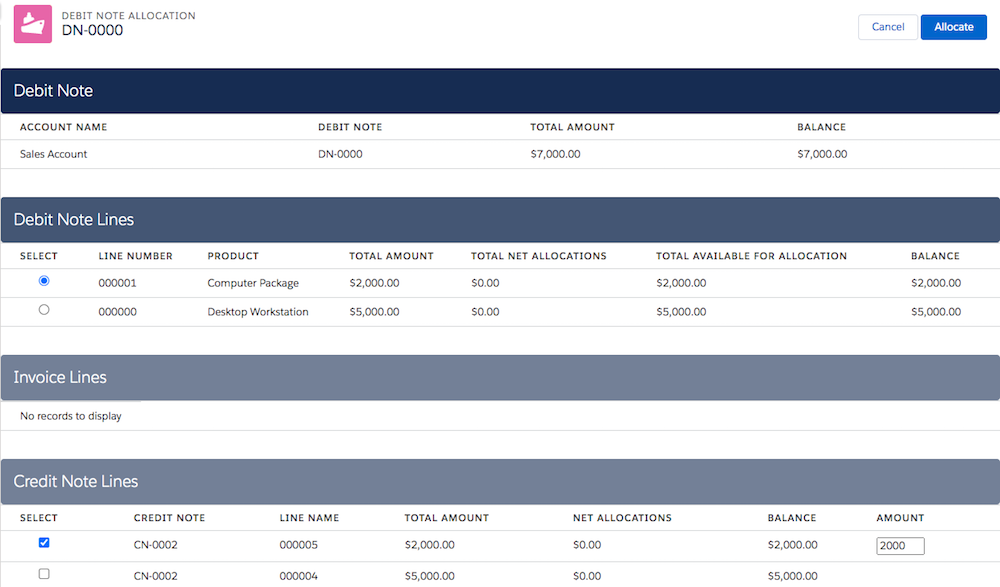
From the debit note’s detail page, click Allocate.
Select your debit note line, and then select the credit note containing an equal
balance.
On the credit note line, enter an amount equal to the debit note line’s balance, and then
click Allocate. Confirm that the credit note line now has a balance of
0.
Repeat
steps B and C for each of the erroneous credit
note’s credit note lines.
After you offset all the credit note lines, the credit note has a balance of 0.
To return to your debit note detail page, click Cancel.
Clicking Cancel doesn’t cancel any of the allocations that you made.
Example In this example, a user must offset an erroneous credit note containing two credit note
lines. They created a debit note containing two debit note lines each of which matches the
balance of a credit note line. They first allocate debit note line 1 to credit note line 5, and
then allocate debit note line 0 to credit note line 4.
Did this article solve your issue?
Let us know so we can improve!
Loading
Salesforce Help | Article
Cookie Consent Manager
General Information
Required Cookies
Functional Cookies
Advertising Cookies
General Information
We use three kinds of cookies on our websites: required, functional, and advertising. You can choose whether functional and advertising cookies apply. Click on the different cookie categories to find out more about each category and to change the default settings.
Privacy Statement
Required Cookies
Always Active
Required cookies are necessary for basic website functionality. Some examples include: session cookies needed to transmit the website, authentication cookies, and security cookies.
Functional Cookies
Functional cookies enhance functions, performance, and services on the website. Some examples include: cookies used to analyze site traffic, cookies used for market research, and cookies used to display advertising that is not directed to a particular individual.
Advertising Cookies
Advertising cookies track activity across websites in order to understand a viewer’s interests, and direct them specific marketing. Some examples include: cookies used for remarketing, or interest-based advertising.