When you use CPQ and Billing together, we recommend aligning CPQ’s Subscription
Proration Precision with Billing’s Proration Type. Otherwise, the proration methods can cause
unwanted differences between an invoice line’s balance and the customer’s expected billings based
on the product’s price. (Salesforce Billing Managed Package)
Required Editions
Available in: Salesforce Billing 212.5 and later
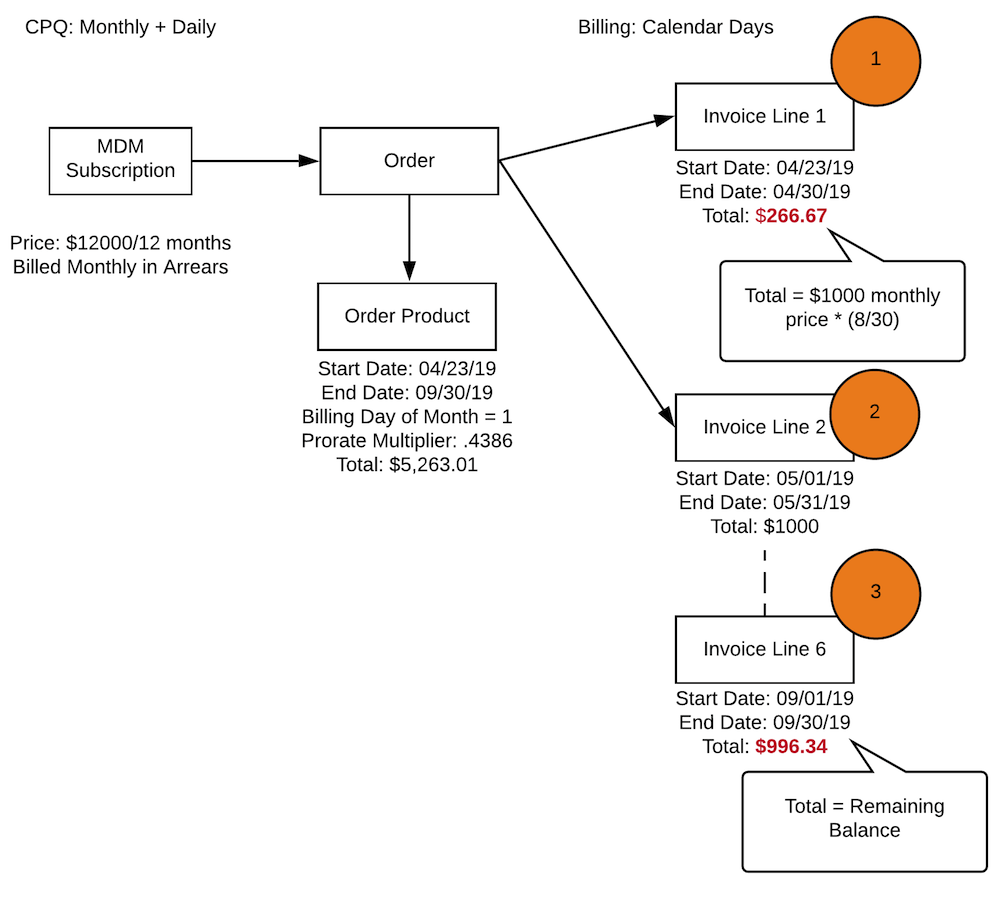
Let’s start out by examining an order product billed $1000 monthly in arrears for a 12-month
term. CPQ uses Monthly + Daily proration settings, while Billing uses Calendar Days. A sales rep
quotes it for 04/23 through 09/30/19, then orders and invoices it.
In (1), the first billing period in April is prorated to run from 04/23/19 through 04/30/19.
This period represents one difference in proration between CPQ and Billing - when CPQ calculated
proration, it counted forward by month starting on 04/23/19. We moved through 7 whole months and
used 09/23 through 09/30 as our final period for calculating proration. However, Billing prorates
based on when the order product invoices: Since we’re billing monthly in advance, our first
period for proration is 04/23 through 04/30.
Moving through the next four full months of invoicing at $1000 per month, we arrive at a total
of $4,266.67 (2). The final billing period of 09/01 through 09/30 must cover the order product’s
remaining balance, so the invoice line has a total balance of $996.34 (3).
However, this balance represents the discrepancy from the current proration configurations: The
product had a monthly price of $1000, yet the billing is at $996.34 for the full month of
September. Even though the invoice lines add up to $5,263.01 like the order product’s total, most
customers would expect to pay the product’s price of $1000 per month in a full, non-prorated
month.
Alignment Option 1
Our best option for alignment is to continue using Monthly + Daily proration in CPQ while
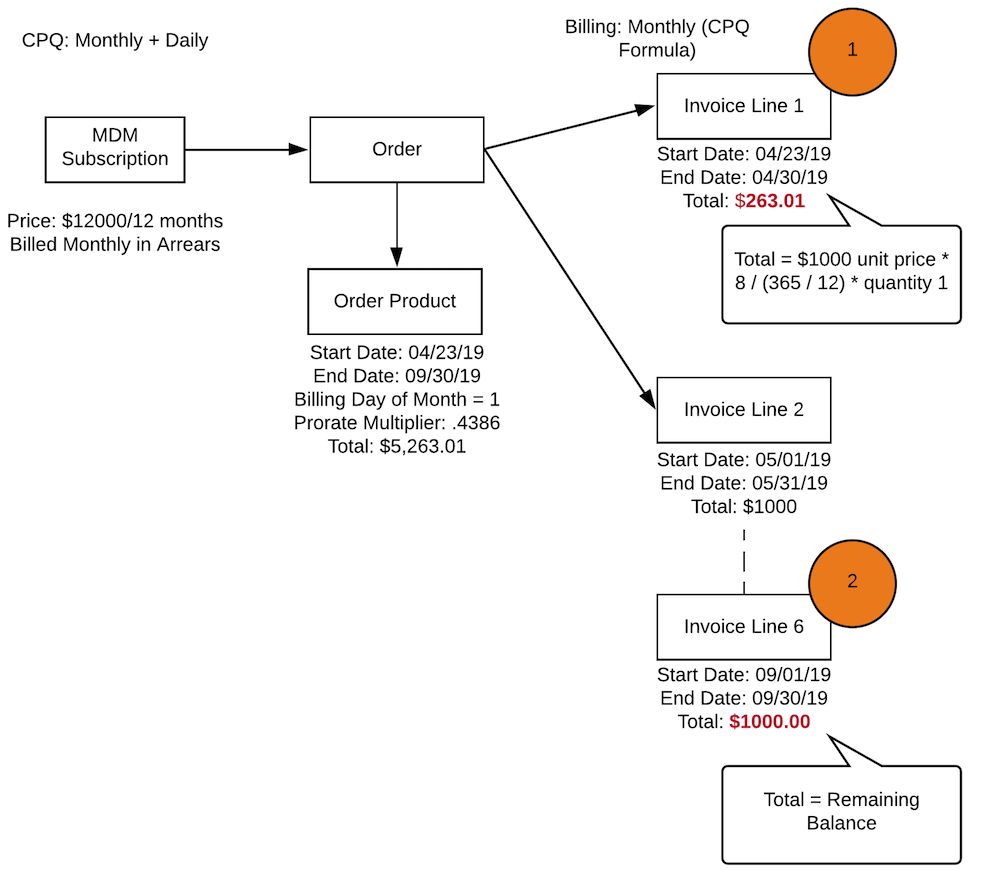
changing our Billing proration type to Monthly (CPQ Formula). While this value is active,
Billing uses (365/12) as the length of a month. Let’s see what happens Months (CPQ Method) is
active in our same example.
In this case, the first period (1) has a prorated balance of $263.01. The next four full
months bring the total to $4263.01. Now, the remaining balance in September (2) is $1000,
aligning with the expected charge based on the product’s original price of $12000 over 12
months.
Aligning for Terms with Start and End Months of Different Lengths
Make sure to account for differences in month lengths when configuring proration between CPQ
and Billing. If the first and last billing periods are in months with different lengths, the
final billing period still differs from the product’s monthly price even when proration methods
are aligned.
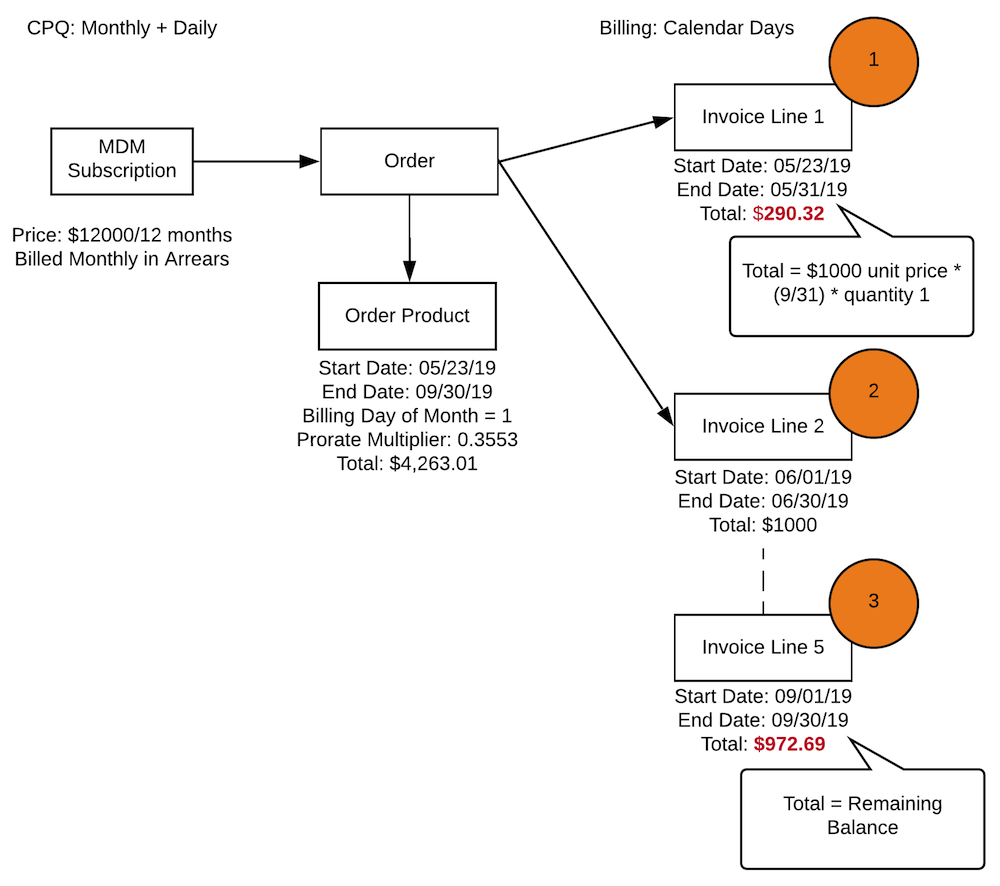
Let’s return to the first example of the same product, but quoted from 05/23/19 through
09/30/19. In this case, the initial billing period lasts for 9/31 days, producing a slightly
larger value than 8/30. This larger billing period, alongside the shorter final month length in
September, means that the final billing period has a smaller remaining balance to invoice.
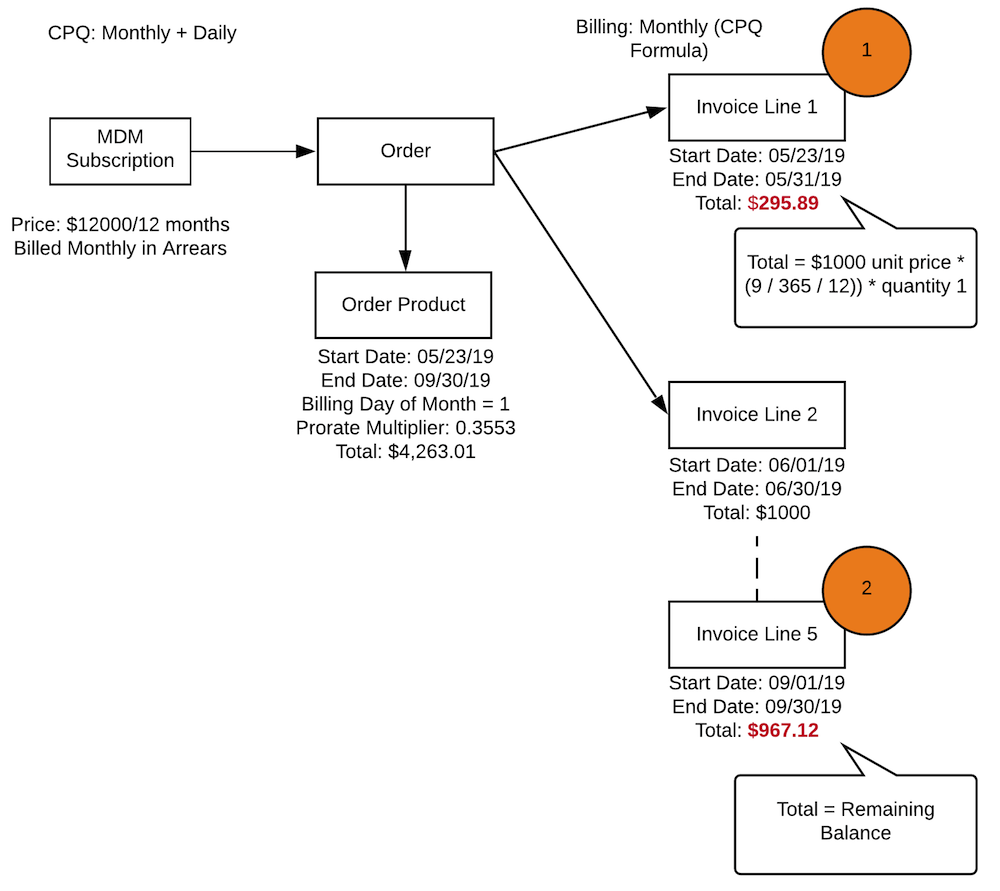
When we change Salesforce Billing’s prorate type to CPQ Method, our final invoice line has a
slightly larger difference from the monthly rate of $1000.
Did this article solve your issue?
Let us know so we can improve!
Loading
Salesforce Help | Article
Cookie Consent Manager
General Information
Required Cookies
Functional Cookies
Advertising Cookies
General Information
We use three kinds of cookies on our websites: required, functional, and advertising. You can choose whether functional and advertising cookies apply. Click on the different cookie categories to find out more about each category and to change the default settings.
Privacy Statement
Required Cookies
Always Active
Required cookies are necessary for basic website functionality. Some examples include: session cookies needed to transmit the website, authentication cookies, and security cookies.
Functional Cookies
Functional cookies enhance functions, performance, and services on the website. Some examples include: cookies used to analyze site traffic, cookies used for market research, and cookies used to display advertising that is not directed to a particular individual.
Advertising Cookies
Advertising cookies track activity across websites in order to understand a viewer’s interests, and direct them specific marketing. Some examples include: cookies used for remarketing, or interest-based advertising.