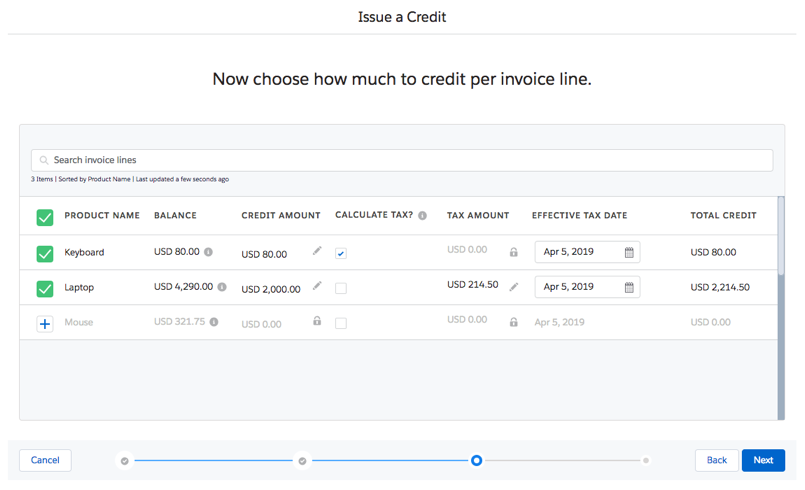
Billing operations and customer service teams can use the Credit Center to quickly
credit multiple invoice lines on an invoice. They can credit invoice lines, apply tax per credit
note line, and preview the results of the credit note before posting it to the
invoice. (Salesforce Billing Managed Package)
Required Editions
Available in: Salesforce Billing Summer ’19 and later with the CPQ & Billing Plus
license
After a billing ops user clicks Credit Center on their account,
Salesforce Billing launches the Credit Center and shows all the posted invoices with positive or
negative outstanding balances on their account. When they select an invoice, the Credit Center
lets them credit any of its invoice lines. They can also calculate credit note line tax with the
tax engine used for the invoice line, calculate credit note line tax manually, or choose not to
calculate credit note line tax.
When they're done setting up the credit note, Salesforce Billing creates a draft credit note
record with a credit note line for each invoice line that they credited. Users can review the new
invoice line balances while the note is still in draft status and make further changes if needed,
or post the credit note to apply the credits.
Guidelines for Using the Credit Center If you’re on a billing operations or customer service team, you can use the Credit Center to credit invoice lines on a customer account. When you’re working in the Credit Center, take note of a few key guidelines. (Salesforce Billing Managed Package)
Did this article solve your issue?
Let us know so we can improve!
Loading
Salesforce Help | Article
Cookie Consent Manager
General Information
Required Cookies
Functional Cookies
Advertising Cookies
General Information
We use three kinds of cookies on our websites: required, functional, and advertising. You can choose whether functional and advertising cookies apply. Click on the different cookie categories to find out more about each category and to change the default settings.
Privacy Statement
Required Cookies
Always Active
Required cookies are necessary for basic website functionality. Some examples include: session cookies needed to transmit the website, authentication cookies, and security cookies.
Functional Cookies
Functional cookies enhance functions, performance, and services on the website. Some examples include: cookies used to analyze site traffic, cookies used for market research, and cookies used to display advertising that is not directed to a particular individual.
Advertising Cookies
Advertising cookies track activity across websites in order to understand a viewer’s interests, and direct them specific marketing. Some examples include: cookies used for remarketing, or interest-based advertising.