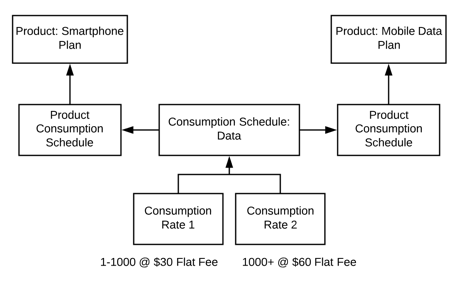
Salesforce uses a linking object, called a product consumption schedule, to define a
relationship between the product and the consumption schedule. The product consumption schedule
has a one-to-many relationship with products, which lets you associate multiple schedules with
the same product. You can also associate one consumption schedule with several
products. (Salesforce CPQ Managed Package)
Required Editions
Available in: Salesforce CPQ Spring ’19 and later
These limits apply to consumption schedules:
A consumption schedule can include up to 100 product consumption schedules
A product can include up to 100 product consumption schedules
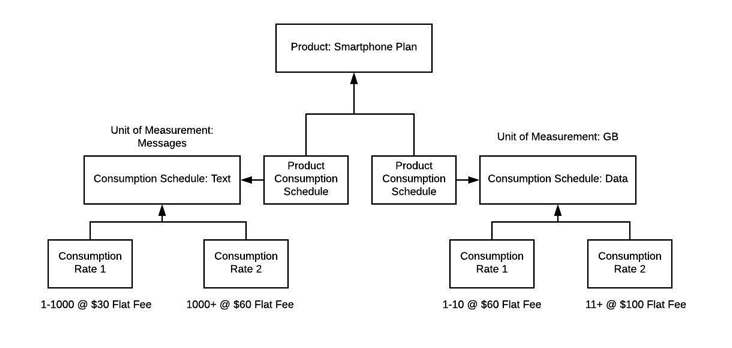
This structure is useful when you have a product associated with several different types of
usage — for example, a phone data plan with usage-priced texting and usage-priced data
consumption. Since both usage types have different units of measurements, you need two usage
schedules. Let's take a quick look at how you can set this up.
You can also associate one consumption schedule with several products. This structure is
useful when you have different products that still have the same usage pricing system.
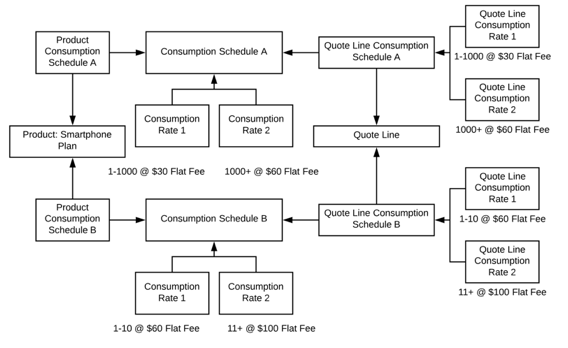
When you quote, order, or contract this usage product, the resulting record receives one new
consumption schedule for each consumption schedule on the original product. For example, let's
say a sales rep quoted the phone plan. Salesforce CPQ creates quote line consumption schedules
from the original consumption schedule and associates them both with the resulting quote line.
You can access them from your quote line's Quote Line Consumption Schedule related list.
Did this article solve your issue?
Let us know so we can improve!
Loading
Salesforce Help | Article
Cookie Consent Manager
General Information
Required Cookies
Functional Cookies
Advertising Cookies
General Information
We use three kinds of cookies on our websites: required, functional, and advertising. You can choose whether functional and advertising cookies apply. Click on the different cookie categories to find out more about each category and to change the default settings.
Privacy Statement
Required Cookies
Always Active
Required cookies are necessary for basic website functionality. Some examples include: session cookies needed to transmit the website, authentication cookies, and security cookies.
Functional Cookies
Functional cookies enhance functions, performance, and services on the website. Some examples include: cookies used to analyze site traffic, cookies used for market research, and cookies used to display advertising that is not directed to a particular individual.
Advertising Cookies
Advertising cookies track activity across websites in order to understand a viewer’s interests, and direct them specific marketing. Some examples include: cookies used for remarketing, or interest-based advertising.