Salesforce Spiff Release Notes for October 29, 2025
Expand the customization, precision, and sophistication of your incentive compensation management plans with Salesforce Spiff. Create custom roles with the specific combination of permissions you want users to have.
Required Editions
Available in: both Salesforce Classic (not available in all orgs) and Lightning
Experience
Available in: Enterprise, Unlimited, and Developer
Editions
Available for an additional cost in: Professional Edition with Web
Services API Enabled
Fine-tune Access Control for Incentive Compensation Functionality with Custom Roles
Implement a more trusted, efficient environment for managing your company’s unique incentive compensation resources. Instead of trying to fit your users into default Salesforce Spiff roles, create custom roles where you can give access to only the specific functionality that different groups of users need to be successful. Get started quickly by selecting an existing role that you want to use as a starting point.
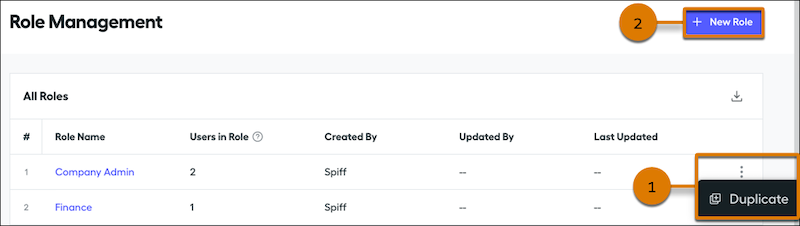
How: From the Admin menu, select Role Management, where you
can duplicate an existing role. Find a role in the list, click the three dots menu, and select Duplicate (1). Or, click New Role (2) and select an existing role that you want to duplicate.
Custom roles have these limitations.
After you create a custom role, it can take up to two minutes before the new role
can be assigned to a user. After you edit a custom role that’s assigned to a
user, it can take up to two minutes before the user’s account reflects the
changed permissions.
When you import user records or sync user records with a connector, you can’t specify a custom role. You can only assign custom roles to individual users that have been created in Spiff.
We use three kinds of cookies on our websites: required, functional, and advertising. You can choose whether functional and advertising cookies apply. Click on the different cookie categories to find out more about each category and to change the default settings.
Privacy Statement
Required Cookies
Always Active
Required cookies are necessary for basic website functionality. Some examples include: session cookies needed to transmit the website, authentication cookies, and security cookies.
Functional Cookies
Functional cookies enhance functions, performance, and services on the website. Some examples include: cookies used to analyze site traffic, cookies used for market research, and cookies used to display advertising that is not directed to a particular individual.
Advertising Cookies
Advertising cookies track activity across websites in order to understand a viewer’s interests, and direct them specific marketing. Some examples include: cookies used for remarketing, or interest-based advertising.