Archiving Synced Salesforce Records in Salesforce Spiff
When you use the Salesforce connector in Salesforce Spiff but records aren't available for syncing in Salesforce, Spiff archives the records. Archived records are soft-deleted and hidden from view, but you can restore them.
Required Editions
Available in: both Salesforce Classic (not available in all orgs) and Lightning
Experience
Available in: Enterprise, Unlimited, and Developer
Editions
Available for an additional cost in: Professional Edition with Web
Services API Enabled
If the Salesforce API doesn’t return a record in a request during a sync, Spiff determines that the record no longer exists and must be archived. However, frozen statements require that records exist in Spiff even if the corresponding records were deleted in Salesforce.
Each record in Spiff has a field called soft_deleted. When this field is true, the record is considered archived. When this field is false, the record is active. Spiff sets that value during a sync.
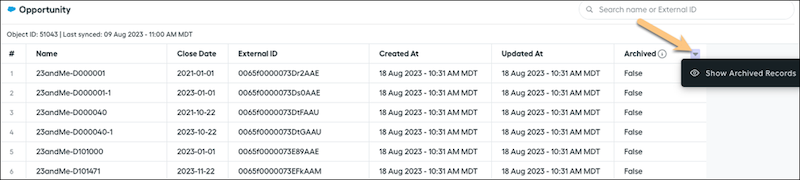
In the Data Sources page, the Archived column includes an option, Show Archived Records, that's off by default. When this option is turned on, archived records appear in your list of records and are searchable.
We use three kinds of cookies on our websites: required, functional, and advertising. You can choose whether functional and advertising cookies apply. Click on the different cookie categories to find out more about each category and to change the default settings.
Privacy Statement
Required Cookies
Always Active
Required cookies are necessary for basic website functionality. Some examples include: session cookies needed to transmit the website, authentication cookies, and security cookies.
Functional Cookies
Functional cookies enhance functions, performance, and services on the website. Some examples include: cookies used to analyze site traffic, cookies used for market research, and cookies used to display advertising that is not directed to a particular individual.
Advertising Cookies
Advertising cookies track activity across websites in order to understand a viewer’s interests, and direct them specific marketing. Some examples include: cookies used for remarketing, or interest-based advertising.