Updating a Salesforce Connector in Salesforce Spiff
After you connect a Salesforce environment to Salesforce spiff, you can swap the connected environment for a different one, such as switching between production or sandbox. Or if you're a new Spiff admin who inherited a Salesforce connector that a different admin previously authenticated, reauthenticate the connector with the same credentials.
Required Editions
Available in: both Salesforce Classic (not available in all orgs) and Lightning
Experience
Available in: Enterprise, Unlimited, and Developer
Editions
Available for an additional cost in: Professional Edition with Web
Services API Enabled
Swapping Orgs
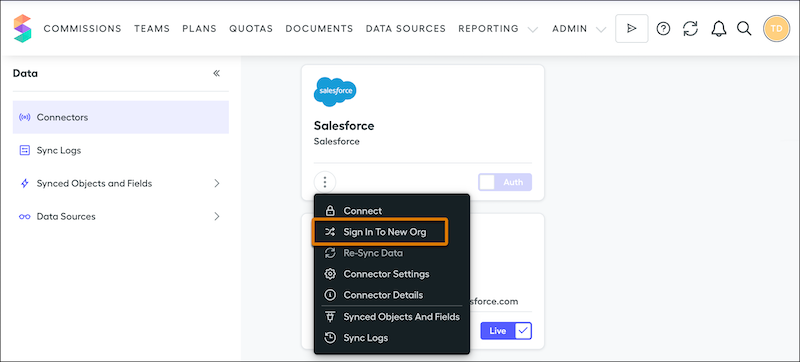
To sign in to a different org, click the three dots on the connector and select Sign In To New Org.
In the window that appears, click New Sign in, select a sandbox or
production environment, and continue with authenticating to the new org. See Add a Salesforce Connector.
Plan for these changes when you connect to a different org.
To avoid accidentally connecting Spiff to the wrong Salesforce org, log out of all Salesforce orgs that you’ve been using in your browser.
When you change the connected org, Spiff doesn't delete any mappings, fields, or data. If the new connected environment uses the same object schema as the previous connected environment, Spiff reuses the previous data mapping. If you plan to swap between sandbox and production, make sure that the object schema of the sandbox environment matches the object schema of the production environment. See Create or Edit Sandbox Templates.
Only one Salesforce connector can map to the Spiff user object. If you set up another Salesforce connector and try to map to the Spiff user object again, Spiff prevents you from proceeding.
Reauthenticating a Connector
If a different admin previously authenticated the connector, the new admin must reauthenticate with the same credentials.
To see which user previously authenticated the connector, click the three dots on the connector card and select More Info.
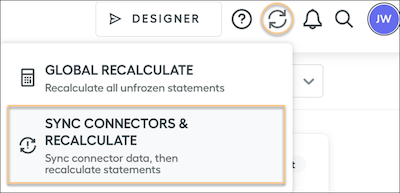
To reauthenticate the connector, click the three dots on the connector card and select Reauthenticate. After establishing the connection, click the Global Sync Actions icon.
Did this article solve your issue?
Let us know so we can improve!
Loading
Salesforce Help | Article
Cookie Consent Manager
General Information
Required Cookies
Functional Cookies
Advertising Cookies
General Information
We use three kinds of cookies on our websites: required, functional, and advertising. You can choose whether functional and advertising cookies apply. Click on the different cookie categories to find out more about each category and to change the default settings.
Privacy Statement
Required Cookies
Always Active
Required cookies are necessary for basic website functionality. Some examples include: session cookies needed to transmit the website, authentication cookies, and security cookies.
Functional Cookies
Functional cookies enhance functions, performance, and services on the website. Some examples include: cookies used to analyze site traffic, cookies used for market research, and cookies used to display advertising that is not directed to a particular individual.
Advertising Cookies
Advertising cookies track activity across websites in order to understand a viewer’s interests, and direct them specific marketing. Some examples include: cookies used for remarketing, or interest-based advertising.