The possibilities for data filters in Salesforce Spiff are extensive, depending on the complexity and depth of your data. For best performance, get as specific as possible with a filter before you add a calculation. Simple Guided or Nested Guided mode can help you easily create simple, useful filters. With Nested Guided mode, combine prebuilt data filters together using AND or OR operators.
Required Editions
Available in: both Salesforce Classic (not available in all orgs) and Lightning
Experience
Available in: Enterprise, Unlimited, and Developer
Editions
Available for an additional cost in: Professional Edition with Web
Services API Enabled
ByRep
Show all deals associated with a certain rep. This filter is available by default.
OwnerId = rep.Id
In Salesforce, the OwnerId field on the Opportunity object identifies the rep that closed a deal, but you can reference a different field.
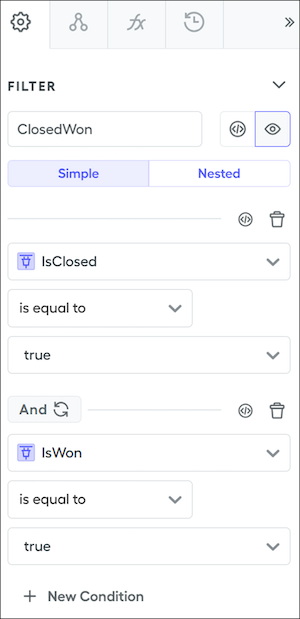
ClosedWon
Show all deals that are closed and won. This filter is available by default.
(IsClosed=TRUE) AND (IsWon=TRUE)
In Salesforce, the IsClosed and IsWon fields on the Opportunity object specify these statuses. This filter shows all deals for all reps and statement periods.
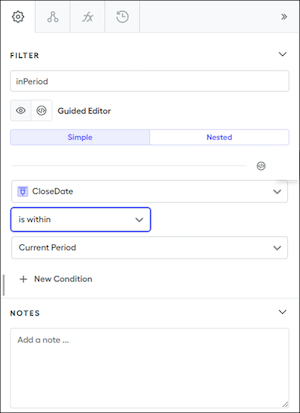
InPeriod
Show only deals with a close date in a specific period. This filter is available by default. For example, show deals that closed within the current month or deals that closed before the start of a statement period.
In Designer, create a filter on the Deals object and select these values.
CloseDate
isWithin
Current Period
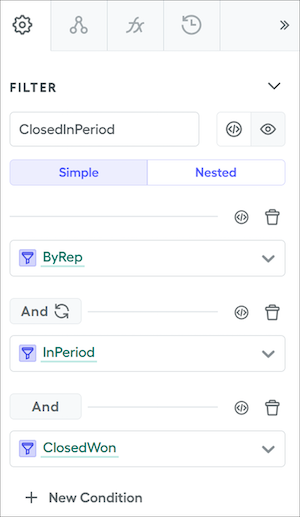
ClosedInPeriod
Show only deals that are closed and won by a specific rep within a specific statement period.
ByRep AND InPeriod AND ClosedWon
In Designer, create a filter on the Deals object and join the prebuilt ByRep, InPeriod, and ClosedWon filters with AND operators.
Tip When you enter the name of a filter that's already been created, the name changes color to indicate that Spiff recognizes the filter.
By String Value
When you're filtering string data types, enclose strings in quotes and pay close attention to spelling and capitalization.
Find All Possible Field Values
To return a list of all possible values for a field, create a data filter for the object that returns all types, then create a calculated field on the object.
For example, to return all opportunity types, create this data filter.
TypeNotNull = Type != null
Then create this calculated field on the Opportunity object.
We use three kinds of cookies on our websites: required, functional, and advertising. You can choose whether functional and advertising cookies apply. Click on the different cookie categories to find out more about each category and to change the default settings.
Privacy Statement
Required Cookies
Always Active
Required cookies are necessary for basic website functionality. Some examples include: session cookies needed to transmit the website, authentication cookies, and security cookies.
Functional Cookies
Functional cookies enhance functions, performance, and services on the website. Some examples include: cookies used to analyze site traffic, cookies used for market research, and cookies used to display advertising that is not directed to a particular individual.
Advertising Cookies
Advertising cookies track activity across websites in order to understand a viewer’s interests, and direct them specific marketing. Some examples include: cookies used for remarketing, or interest-based advertising.