Create a Payout Rule for the Quota Attainment Graph
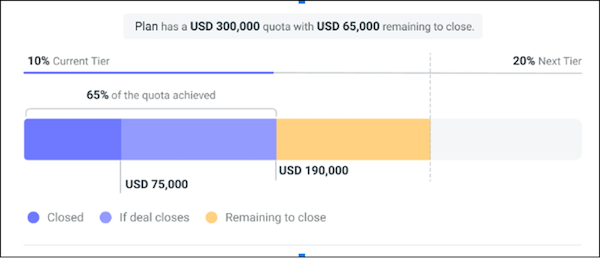
The Commission Estimator window in the Salesforce Spiff Commission Estimator provides a bar graph that shows how much an estimated deal affects quota attainment. In Designer, create a quota payout rule for use with the quota attainment graph. The payout rule has several requirements.
Required Editions
Available in: both Salesforce Classic (not available in all orgs) and Lightning
Experience
Available in: Enterprise, Unlimited, and Developer
Editions
Available for an additional cost in: Professional Edition with Web
Services API Enabled
Before you create the rule, review these requirements.
If users belong to multiple plans, they can have multiple quotas, so choose the most important quota to show the graph for.
If a commission plan doesn't use quotas or quota attainment, create the payout rule and data filter anyway. In this case, the filter doesn't return any result, and the graph is hidden.
If more than one plan uses the Spiff Commission Estimator, the payout rule must be the same for all plans that use the same object. If the plans have different formulas for the required fields, create a lookup table, based on the plan name, that provides the appropriate field values dynamically.
In Designer, create a payout rule with these requirements.
Name
sce_chart_opportunity or sce_chart_quote, depending on the object used in the plan
Ghost rule
True
See Payout Rules. This rule isn't visible in plan commission statements but is required for the bar graph. If you use both the Quote and Opportunity objects, create a rule for each object.
Create a data filter on the payout rule, and specify these requirements.
Return only one opportunity or quote when an estimate is requested, per plan. If the data filter returns multiple opportunities or quotes, the Spiff Commission Estimator shows an error.
If the payout rule uses the Quote or Quote Line objects, create the data filter on the Quote object only.
If the payout rule uses the Opportunity or Opportunity Product objects, create the data filter on the Opportunity object only.
We use three kinds of cookies on our websites: required, functional, and advertising. You can choose whether functional and advertising cookies apply. Click on the different cookie categories to find out more about each category and to change the default settings.
Privacy Statement
Required Cookies
Always Active
Required cookies are necessary for basic website functionality. Some examples include: session cookies needed to transmit the website, authentication cookies, and security cookies.
Functional Cookies
Functional cookies enhance functions, performance, and services on the website. Some examples include: cookies used to analyze site traffic, cookies used for market research, and cookies used to display advertising that is not directed to a particular individual.
Advertising Cookies
Advertising cookies track activity across websites in order to understand a viewer’s interests, and direct them specific marketing. Some examples include: cookies used for remarketing, or interest-based advertising.