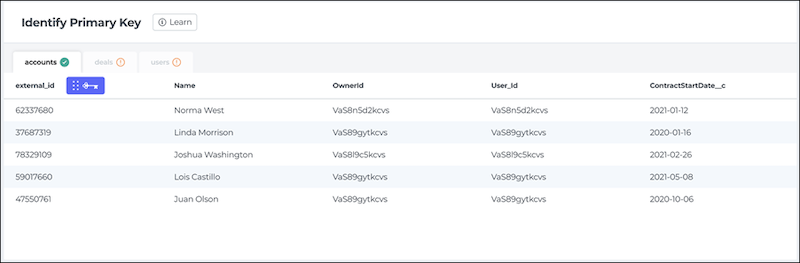
A primary key helps Salesforce Spiff differentiate records based on a unique ID and determine whether to add new rows or update existing rows on new imports. This value must be unique for each record.
Required Editions
Available in: both Salesforce Classic (not available in all orgs) and Lightning
Experience
Available in: Enterprise, Unlimited, and Developer
Editions
Available for an additional cost in: Professional Edition with Web
Services API Enabled
The primary key for an object is locked after the first upload when the key is selected. Locking the primary key ensures that the same field is used for future imports of updated data.
The primary key field can't contain special characters or spaces. The most common name used for a primary key field is external_id, and this name is required for these objects.
accounts
assets
conversion_rates
deals
deal_splits
deal_split_types
deal_team_members
events
invoices
line_items
payers
payments
products
quotas
quota_types
tasks
users
For other objects, you can use any name, such as PrimaryKey or UniqueIdentifier. If an object has already been uploaded and a primary key has been selected, use the same name.
The value of each record's primary key must be unique. If you don't already have a field that’s unique to each record, create alphanumeric entries that you can easily add. Or, concatenate other field values to form a unique value, which provides a more human-readable way to find specific records.
If you want to upload additional data to an object but you aren't sure what the primary key field is, go to Data Sources, click on Imported Tables in Data Imports. Hover over the three dots next to the object and export a template of fields.
We use three kinds of cookies on our websites: required, functional, and advertising. You can choose whether functional and advertising cookies apply. Click on the different cookie categories to find out more about each category and to change the default settings.
Privacy Statement
Required Cookies
Always Active
Required cookies are necessary for basic website functionality. Some examples include: session cookies needed to transmit the website, authentication cookies, and security cookies.
Functional Cookies
Functional cookies enhance functions, performance, and services on the website. Some examples include: cookies used to analyze site traffic, cookies used for market research, and cookies used to display advertising that is not directed to a particular individual.
Advertising Cookies
Advertising cookies track activity across websites in order to understand a viewer’s interests, and direct them specific marketing. Some examples include: cookies used for remarketing, or interest-based advertising.