Payout rules let you create calculations that determine how your reps earn a commission. Line-by-line rules calculate a commission amount by applying a calculation to each item in a data filter such as a deal or an opportunity. Calculation output from each item is summed to get the total for the rule.
Required Editions
Available in: both Salesforce Classic (not available in all orgs) and Lightning
Experience
Available in: Enterprise, Unlimited, and Developer
Editions
Available for an additional cost in: Professional Edition with Web
Services API Enabled
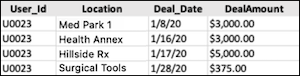
A common filter is for deals closed by a rep in a period. In this scenario, a rep has four deals in their closed-in period data filter.
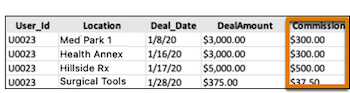
Define a line-by-line rule calculation as 10% of the Deal Amount.This calculation appliesto the four deals. Each record has its respective deal amount multiplied by 10% to get the outputs in the Commission column. The output of these calculations in the Commission column is summed to get the rule total. Commission plans can be complex, but understanding the concept helps you determine what approach to take when building your own rules.
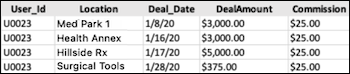
Another line-by-line rule example is when a rep earns $25 for each new subscription they sell. Every deal flagged as a new subscription is the data filter and each new subscription receives the $25 commission. The Commission column is the calculation applied to each deal. The rep earns $100 in total commission for this rule.
Did this article solve your issue?
Let us know so we can improve!
Loading
Salesforce Help | Article
Cookie Consent Manager
General Information
Required Cookies
Functional Cookies
Advertising Cookies
General Information
We use three kinds of cookies on our websites: required, functional, and advertising. You can choose whether functional and advertising cookies apply. Click on the different cookie categories to find out more about each category and to change the default settings.
Privacy Statement
Required Cookies
Always Active
Required cookies are necessary for basic website functionality. Some examples include: session cookies needed to transmit the website, authentication cookies, and security cookies.
Functional Cookies
Functional cookies enhance functions, performance, and services on the website. Some examples include: cookies used to analyze site traffic, cookies used for market research, and cookies used to display advertising that is not directed to a particular individual.
Advertising Cookies
Advertising cookies track activity across websites in order to understand a viewer’s interests, and direct them specific marketing. Some examples include: cookies used for remarketing, or interest-based advertising.