A lump-sum rule pays out one obligation amount that you define with calculations. The final payout calculation comes from a single cell in a worksheet. Worksheets contain formulas that have a single value, either entered directly or as the result of a formula.
Required Editions
Available in: both Salesforce Classic (not available in all orgs) and Lightning
Experience
Available in: Enterprise, Unlimited, and Developer
Editions
Available for an additional cost in: Professional Edition with Web
Services API Enabled
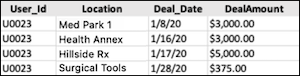
In this example, a rep's commission is calculated each month by multiplying their monthly attainment by their $4,500 monthly target variable compensation. Assume that the rep has a monthly quota of $20,000 and they’ve closed four deals.
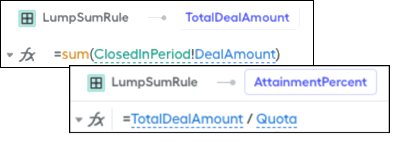
A lump-sum rule doesn't apply a calculation to each item in this filter. Instead, this rule sums the deal amount field to eventually determine the rep's attainment.
Calculate the rep's sum for the amount closed in the period, TotalDealAmount. The four deals sum 3,000 + 3,000 + 5,000 + 375, which results in $11,375 for the period.
=sum(ClosedInPeriod!DealAmount)
To find the rep's AttainmentPercent, divide the sum by the quota.
=TotalDealAmount/Quota
Because the rep has a $20,000 quota, $11,375 divided by $20,000 results in 56.9% attainment for the rep that month. To calculate the rep's LumpSumCommission, the input criteria multiplies the attainment by the TargetVariableCompensation value of $4,500. The rep ends up taking home around $2,560.50 for the month.
=TargetVariableCompensation*AttainmentPercent
Lump-sum rules are also helpful when you want to provide an incentive when reps exceed a target. For example, when the total annual recurring revenue from renewals that a rep brings in monthly is greater than $15,000, maybe the rep receives a $1,000 bonus.
Note When you create a lump-sum rule, the functions and tracing that you select determine which records are shown in statements.
Did this article solve your issue?
Let us know so we can improve!
Loading
Salesforce Help | Article
Cookie Consent Manager
General Information
Required Cookies
Functional Cookies
Advertising Cookies
General Information
We use three kinds of cookies on our websites: required, functional, and advertising. You can choose whether functional and advertising cookies apply. Click on the different cookie categories to find out more about each category and to change the default settings.
Privacy Statement
Required Cookies
Always Active
Required cookies are necessary for basic website functionality. Some examples include: session cookies needed to transmit the website, authentication cookies, and security cookies.
Functional Cookies
Functional cookies enhance functions, performance, and services on the website. Some examples include: cookies used to analyze site traffic, cookies used for market research, and cookies used to display advertising that is not directed to a particular individual.
Advertising Cookies
Advertising cookies track activity across websites in order to understand a viewer’s interests, and direct them specific marketing. Some examples include: cookies used for remarketing, or interest-based advertising.