Create a Custom Metric for the Aggregated Value Needed to Reach the Next Accelerator
Tier
Boost motivation by showing reps how close they are to the next accelerator level. Create a custom metric that displays this information on their statements.
Required Editions
Available in: both Salesforce Classic (not available in all orgs) and Lightning
Experience
Available in: Enterprise, Unlimited, and Developer
Editions
Available for an additional cost in: Professional Edition with Web
Services API Enabled
User Permissions Needed
To create a custom metric:
A Spiff user role with these permissions turned on.
Designer Configuration: Manage
Designer Range Tables: Manage
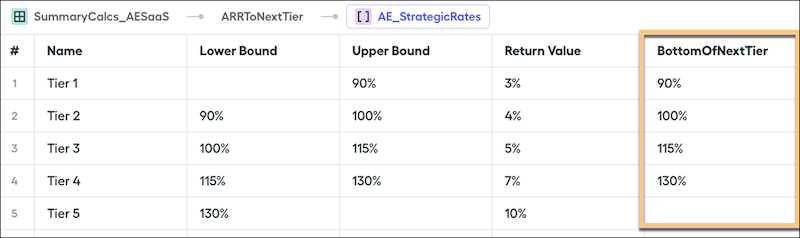
In your range table, add a column named BottomOfNextTier
that calculates accelerators.
You can also build a new range table specifically for this purpose.
Create a worksheet calculation named ARRToNextTier and add this formula, where AttainmentPercent is a worksheet calculation for the sum total or aggregation of all ARR or QuotaAmount.
To avoid an error when the rep has maxed out their tiers, wrap part of the formula with an if function that returns 0 instead of a negative ARR value.
In the rep's statement, add the new custom metric.
Did this article solve your issue?
Let us know so we can improve!
Loading
Salesforce Help | Article
Cookie Consent Manager
General Information
Required Cookies
Functional Cookies
Advertising Cookies
General Information
We use three kinds of cookies on our websites: required, functional, and advertising. You can choose whether functional and advertising cookies apply. Click on the different cookie categories to find out more about each category and to change the default settings.
Privacy Statement
Required Cookies
Always Active
Required cookies are necessary for basic website functionality. Some examples include: session cookies needed to transmit the website, authentication cookies, and security cookies.
Functional Cookies
Functional cookies enhance functions, performance, and services on the website. Some examples include: cookies used to analyze site traffic, cookies used for market research, and cookies used to display advertising that is not directed to a particular individual.
Advertising Cookies
Advertising cookies track activity across websites in order to understand a viewer’s interests, and direct them specific marketing. Some examples include: cookies used for remarketing, or interest-based advertising.