
Some states and municipalities require companies to have a rep approval process for commissionable wages. Some larger companies want to add security in addition to compliance by defining the approval route to prevent system abuse, institute controls, and reduce risk. In Salesforce Spiff, request statement approvals manually or set up an automatic process for end-of-period statement approvals.
Required Editions
Available in: both Salesforce Classic (not available in all orgs) and Lightning
Experience
Available in: Enterprise, Unlimited, and Developer
Editions
Available for an additional cost in: Professional Edition with Web
Services API Enabled
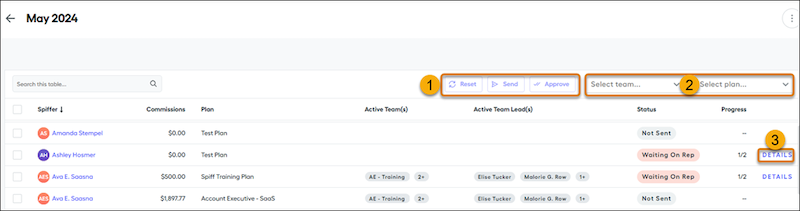
In the Approvals table, within a statement period, send statements for approval, reset approvals, or approve (1) statements for one or more users. Filter users with the plan or team menus (2).
To view approval details for a sent statement, click Details (3). When each approval is complete, the responsible party’s name appears with a timestamp. The admin can approve for all roles.
Approvers receive a notification, depending on their notification settings, when it’s their turn to approve in the workflow.
To export statement approvals and approval history, first export the system activity log in .csv format. Then, in the exported log file, filter the Product/Feature column for history related to approvals.
Set Up Statement Approval Routes Approval routes determine who approves statements, the number of approvers, the order of approvers, approval reminders, and team lead routing. You can define multilevel approval routes with flexible approval structures for end-of-period statement approvals and document approvals. You can also set up an automatic approval process for a default approval route to reduce manual work and avoid delays.
Manage Statement Approvals Manually In the Approvals table, you can send statement approval requests, review statement approval progress, and approve a statement.
We use three kinds of cookies on our websites: required, functional, and advertising. You can choose whether functional and advertising cookies apply. Click on the different cookie categories to find out more about each category and to change the default settings.
Privacy Statement
Required Cookies
Always Active
Required cookies are necessary for basic website functionality. Some examples include: session cookies needed to transmit the website, authentication cookies, and security cookies.
Functional Cookies
Functional cookies enhance functions, performance, and services on the website. Some examples include: cookies used to analyze site traffic, cookies used for market research, and cookies used to display advertising that is not directed to a particular individual.
Advertising Cookies
Advertising cookies track activity across websites in order to understand a viewer’s interests, and direct them specific marketing. Some examples include: cookies used for remarketing, or interest-based advertising.