Loading
Salesforce now sends email only from verified domains. Read More
Sales Performance Management
Table of Contents
Select Filters

          No results
          No results
          Here are some search tips

          Check the spelling of your keywords.
          Use more general search terms.
          Select fewer filters to broaden your search.

          Search all of Salesforce Help
          Teams and Team Hierarchies in Salesforce Spiff

          Teams and Team Hierarchies in Salesforce Spiff

          Your organization can have a complex hierarchy involving multiple team levels. With the team hierarchy visualization, you can view your organization's teams and team structure in a way that captures the intricacies of various parent teams with their associated subteams, and even the subteams within subteams. Team hierarchies can help structure who can view representative statements. It’s also useful for commission rollouts.
          Required Editions

          Available in: both Salesforce Classic (not available in all orgs) and Lightning Experience
          Available in: Enterprise, Unlimited, and Developer Editions
          Available for an additional cost in: Professional Edition with Web Services API Enabled

          Rollups

          Teams can help you manage rollups (also called overrides) where a team lead, manager, or executive receives credit for the team’s achievements, such as revenue, profit, or number of deals closed. For example, maybe a VP or CSO earns commission based on the sum of revenue that the team closed. The team’s revenue rolls up to the executive.

          There are a couple of ways to manage rollups with teams in Spiff.

          • Assign the rollup to plans in Designer. To use this method, turn on rollups in Admin Settings. This method requires additional logic for the corresponding plan in Designer.
          • Use the Guided Rollup Filter Builder in the Data section of Designer. This filter uses the team hierarchies to create a rollup of team deals. After you create a rollup filter, you can reference it in your plan calculations.
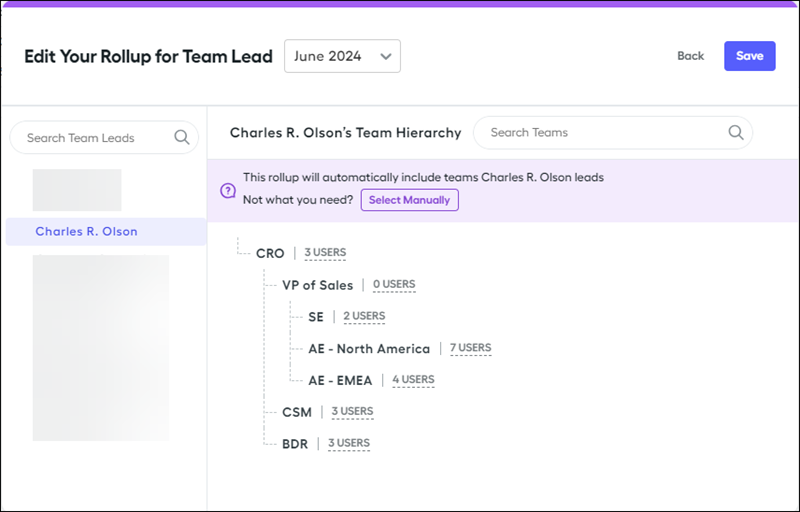
          Edit your rollup for team lead.

          Subteams

          Team hierarchies, where you have a parent team and multiple levels of subteams, can help you give access to records, such as statements, across multiple teams. For example, maybe a user must access statements of users on multiple teams. You can add them as a team lead to every team or create a team where all the direct reports they need to access are assigned as team members. Both strategies are time-consuming and difficult to maintain. Instead, you can use subteams, where you assign the user as a team lead and add other teams instead of adding individual team members. The team lead can see the statements of any members of those teams.

          Note
          Note In this example, the team lead can access only the team members' statements, not the statements of the team leads of the subteams. If you need this person to access the statements of the team leads, you can assign them as team members of the parent team.

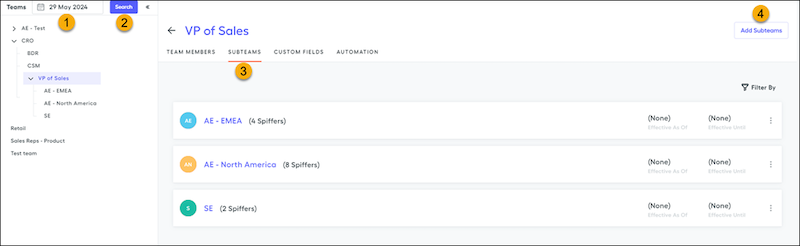
          To view a team’s hierarchy, select a team from the Teams page.

          Team hierarchy view.

          The Teams page provides these options.

          • Show team hierarchies for a specific effective date (1).
          • Search by team name, lead, or member (2).
          • For a selected team in the left panel, manage team leads, subteams, custom fields, or automation options (3).
          • Create subteams (4).
          Tip
          Tip Avoid assigning a team as a subteam of itself, which creates a circular reference that isn't compatible with team hierarchies. Also, a team can't be both a parent and subteam of another team.
           
          Loading
          Salesforce Help | Article