Distribute accounts to reps based on their areas of responsibility, such as industry,
annual revenue, and number of employees. Fine-tune assignment rules and their criteria from
Salesforce territory models and create any other rules that matter for your sales and service
leadership in Territory Planning.
Required Editions
Available in: both Salesforce Classic (not available in all orgs) and Lightning Experience
Available in: Professional, Enterprise, Performance, Unlimited, and Developer Editions with Web Services API enabled
User Permissions Needed
To modify alignments:
Sales Planning Ops Analyst permission set
AND
Query for Datapipelines User for Sales Planning permission set
AND
SF Maps Territory Planning for Sales Planning permission set
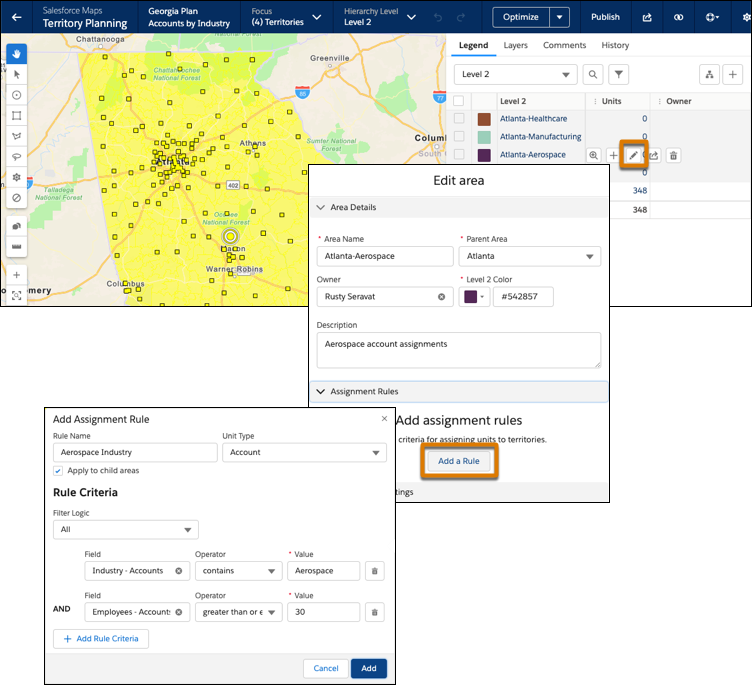
Open an alignment whose units you want to assign using criteria in assignment rules.
Edit an area. In Assignment Rules, click Add a Rule, and then add
criteria for assigning accounts to the area’s owner.
If you assign boundaries to areas, Territory Planning generates boundary rules, which
appear as assignment rules. If you remove boundary assignments, you also remove their
corresponding generated boundary rules.
Save your changes.
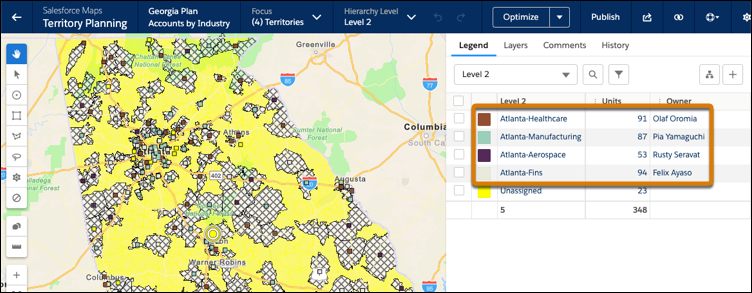
Add account rules and criteria for any other areas in the alignment.
Assignment rules distribute the units to areas based on the criteria that you set.
When you publish alignments to Sales Territories, you also publish your assignment rule
updates and generated boundary rules for accounts.
Did this article solve your issue?
Let us know so we can improve!
Loading
Salesforce Help | Article
Cookie Consent Manager
General Information
Required Cookies
Functional Cookies
Advertising Cookies
General Information
We use three kinds of cookies on our websites: required, functional, and advertising. You can choose whether functional and advertising cookies apply. Click on the different cookie categories to find out more about each category and to change the default settings.
Privacy Statement
Required Cookies
Always Active
Required cookies are necessary for basic website functionality. Some examples include: session cookies needed to transmit the website, authentication cookies, and security cookies.
Functional Cookies
Functional cookies enhance functions, performance, and services on the website. Some examples include: cookies used to analyze site traffic, cookies used for market research, and cookies used to display advertising that is not directed to a particular individual.
Advertising Cookies
Advertising cookies track activity across websites in order to understand a viewer’s interests, and direct them specific marketing. Some examples include: cookies used for remarketing, or interest-based advertising.