Plan Territories for In-Person and Virtual Business
Design territories that include a mix of contiguous and noncontiguous areas in Territory
Planning. Give all your sales and service reps opportunities to meet customers in person and
remotely when you limit assignments within an area. Indicate whether to assign more or fewer units
or containers to an area relative to others within the focus.
Required Editions
Available in: both Salesforce Classic (not available in all orgs) and Lightning Experience
Available in: Professional, Enterprise, Performance, Unlimited, and Developer Editions with Web Services API enabled
User Permissions Needed
To modify alignments:
SF Maps Territory Planning permission set
OR
SF Maps Territory Planning for Sales Planning permission set (after you purchase Sales Planning)
Open an alignment and set the focus. Select an area or a container that you want to set up
for virtual meetings.
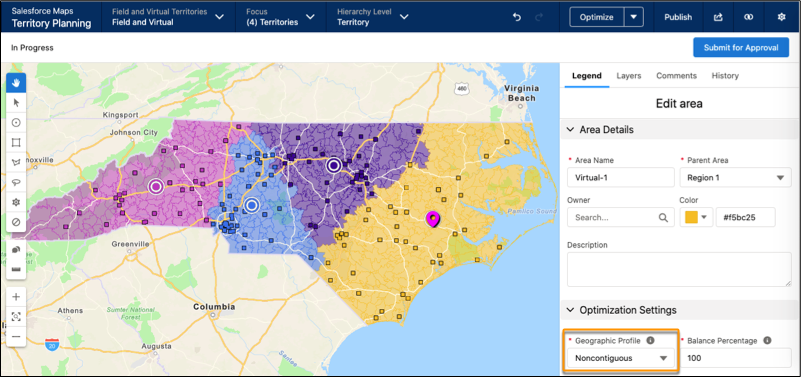
Set the geographic profile to Noncontiguous. If you want to assign
more or fewer units or territories to an area relative to others within the focus, change the
balance percentage. For example, to assign the territory 10% more units relative to other
territories in the focus, enter 110. To assign 15% fewer units, enter
85.
Repeat the previous step for at least one more area or territory.
Save your changes.
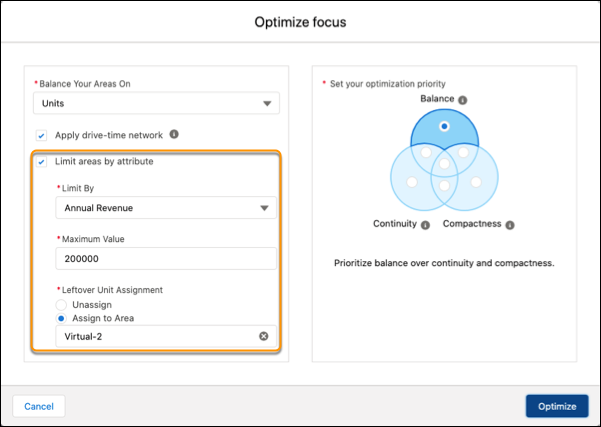
Click Optimize. To ensure that all your reps get a share of
assignments, limit assignments to areas by an attribute such as annual revenue.
Set your optimization priority, then optimize your focus.
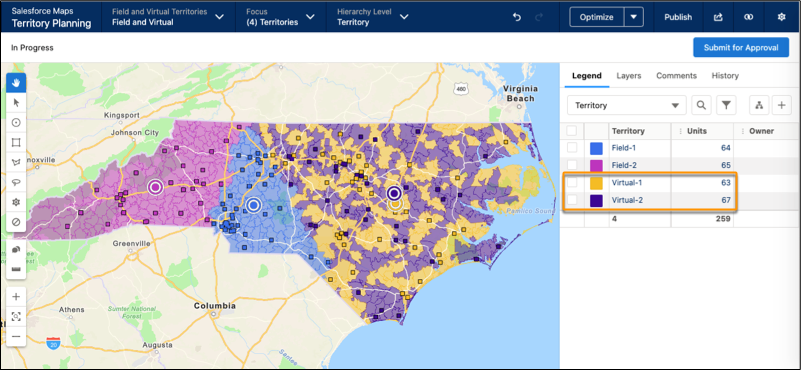
The optimized focus with your contiguous and noncontiguous areas appears on the
map.
Did this article solve your issue?
Let us know so we can improve!
Loading
Salesforce Help | Article
Cookie Consent Manager
General Information
Required Cookies
Functional Cookies
Advertising Cookies
General Information
We use three kinds of cookies on our websites: required, functional, and advertising. You can choose whether functional and advertising cookies apply. Click on the different cookie categories to find out more about each category and to change the default settings.
Privacy Statement
Required Cookies
Always Active
Required cookies are necessary for basic website functionality. Some examples include: session cookies needed to transmit the website, authentication cookies, and security cookies.
Functional Cookies
Functional cookies enhance functions, performance, and services on the website. Some examples include: cookies used to analyze site traffic, cookies used for market research, and cookies used to display advertising that is not directed to a particular individual.
Advertising Cookies
Advertising cookies track activity across websites in order to understand a viewer’s interests, and direct them specific marketing. Some examples include: cookies used for remarketing, or interest-based advertising.