Designate an OAuth User for Data Processing and Optimizations
Assign yourself or a colleague as the OAuth user. Territory Planning processes data
management and alignment optimizations through the OAuth user on Salesforce Maps servers. That
way, nobody’s affected during intensive system processing.
Required Editions
Available in: both Salesforce Classic (not available in all orgs) and Lightning Experience
Available in: Professional, Enterprise, Performance, Unlimited, and Developer Editions with Web Services API enabled
User Permissions Needed
To manage Territory Planning options in the Salesforce Maps package:
Customize Application
Regardless of who creates and manages datasets and alignments, Territory Planning
processes that work through the OAuth user. That user requires access to Territory Planning and
any Salesforce objects involved in the data import process, such as the Account and Opportunity
objects.
To designate yourself as the OAuth user, log in to Salesforce with your username and
password. Or to designate a colleague, ask that colleague to log in to Salesforce with their
username and password.
The person you designate as the OAuth user completes the rest of this procedure.
From Setup, in the Quick Find box, enter Installed Packages, and
then select Installed Packages.
Click Configure next to the Salesforce Maps package.
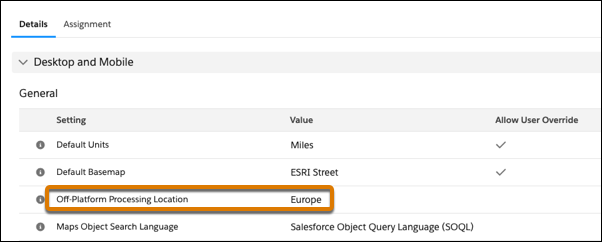
To meet data residency requirements, open your permission groups and
set Off-Platform Processing Location to the location that matches your
Salesforce instance location. For example, your Salesforce instance is based in Europe, so you
set your off-platform processing location to Europe in each permission group.
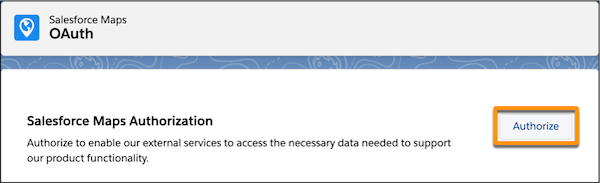
Select OAuth. Then, click Authorize.
Click Allow Access.
Did this article solve your issue?
Let us know so we can improve!
Loading
Salesforce Help | Article
Cookie Consent Manager
General Information
Required Cookies
Functional Cookies
Advertising Cookies
General Information
We use three kinds of cookies on our websites: required, functional, and advertising. You can choose whether functional and advertising cookies apply. Click on the different cookie categories to find out more about each category and to change the default settings.
Privacy Statement
Required Cookies
Always Active
Required cookies are necessary for basic website functionality. Some examples include: session cookies needed to transmit the website, authentication cookies, and security cookies.
Functional Cookies
Functional cookies enhance functions, performance, and services on the website. Some examples include: cookies used to analyze site traffic, cookies used for market research, and cookies used to display advertising that is not directed to a particular individual.
Advertising Cookies
Advertising cookies track activity across websites in order to understand a viewer’s interests, and direct them specific marketing. Some examples include: cookies used for remarketing, or interest-based advertising.