
Configure Recording and Transcription Behavior in a Flow
Gain better administrative flexibility over Contact Center operations and define
specific recording requirements for different parts of a call using flow settings. Add specific
actions to Omni-Channel flows to manage recording and transcription behavior for unique scenarios,
such as disabling audio capture for agent interactions while maintaining transcripts for agent
handoffs.
For example, you can create a flow from the Inbound Routing flow in the Agentforce
Builder. To learn more, see Route Inbound Calls to a Voice-Enabled Agent.
From Setup, in the Quick Find box, enter Flows, and then select Flows.
Add IVR to Your Omni-Channel Flow.
In the section where you want to change the recording behavior, select Set
Recording and Transcription Behavior.
To configure the element, enter a unique name in the Label field that describes the
behavior.
In the Set Input Values section, configure these values:
Disable Recording: Select True to stop recording this segment of the call, or False to
allow recording based on org-level settings.
Disable Transcription: Select True to stop real-time transcription, or False to continue
generating a live transcript in the Conversation window.
VoiceCall Id: Enter the recordId variable to apply the settings to the current active
call.
Save and activate your flow.
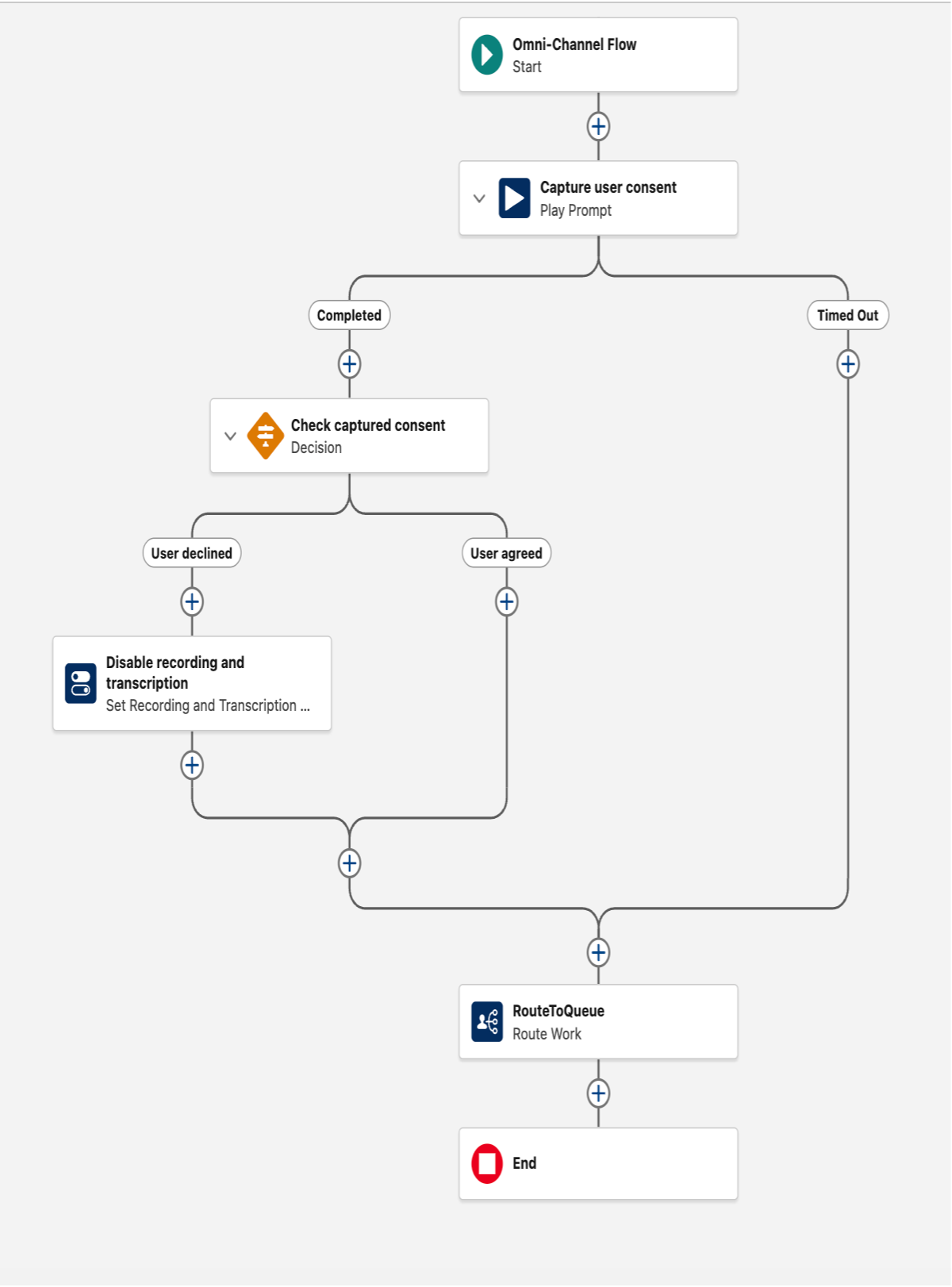
Here’s a sample flow of a recording and transcription behavior for a call segment.
Did this article solve your issue?
Let us know so we can improve!

Loading
Salesforce Help | Article
Cookie Consent Manager
General Information
Required Cookies
Functional Cookies
Advertising Cookies
General Information
We use three kinds of cookies on our websites: required, functional, and advertising. You can choose whether functional and advertising cookies apply. Click on the different cookie categories to find out more about each category and to change the default settings.
Privacy Statement
Required Cookies
Always Active
Required cookies are necessary for basic website functionality. Some examples include: session cookies needed to transmit the website, authentication cookies, and security cookies.
Functional Cookies
Functional cookies enhance functions, performance, and services on the website. Some examples include: cookies used to analyze site traffic, cookies used for market research, and cookies used to display advertising that is not directed to a particular individual.
Advertising Cookies
Advertising cookies track activity across websites in order to understand a viewer’s interests, and direct them specific marketing. Some examples include: cookies used for remarketing, or interest-based advertising.