
You are here:
Modify and Arrange Data Categories
Modifying and arranging categories can result in long processing times, changes to the visibility and categorization of articles, and other significant consequences. Read this entire topic carefully before modifying categories.
Required Editions
| Available in Salesforce Classic and Lightning Experience. View supported editions. |
| User Permissions Needed | |
|---|---|
| To view the Data Categories page: | View Data Categories in Setup |
| To create, edit, or delete data categories: | Manage Data Categories |

Important Modify the category hierarchy when user
activity is low. Because the save process involves potentially large and complex
recalculations, it can take a long time to complete. During processing, support reps can
experience performance issues when searching for articles or questions or using category
dropdown lists.
- From Setup, enter Data Category in the Quick Find box, then select Data Category Setup.
- Click a category group name.
- Optionally, click Expand All to display the full category hierarchy, or Collapse All to display only the top-level categories.
- To edit a category’s name or its unique API name, double-click it.
-
Use drag-and-drop editing to reposition a category in the hierarchy. As you drag, a
red icon indicates an invalid destination, while a green icon indicates a valid
destination.
- Drag a category on top of another category to reposition it as a child of the destination category. For example, drag USA on top of North America to make USA one level below North America. After dragging, the category displays below the other child categories at that level.
- Drag a category to a line that borders another category to reposition it as a sibling of that category. For example, to position USA between Canada and Mexico, drag it to the line between Canada and Mexico.
- To reorder a category's children in alphabetical order, hover your cursor over its name, then choose Order Child Categories Alphabetically from the Actions dropdown list. This reorder only affects the first-level children, not grandchildren or deeper levels.
- As you modify the category hierarchy, click Undo to cancel your last actions. Similarly, click Redo to step forward through your flow of performed actions.
-
Click Save. You receive an email when the save process
completes.
The save process recalculates these visibility and category settings:
- The contents of the category dropdown menu
- The articles and questions visible to each user
- The articles and questions associated with categories.
 Note Save your changes frequently. The more actions you perform before clicking Save, the longer it takes to save.

Example
- How Changing the Hierarchy Affects Article Visibility
- Changing the category hierarchy potentially changes which articles readers can
see. In the example shown in the following graphic,
the
category PDAs moves from the original parent category Computers to the new parent
category Consumer Electronics.Note When a category moves to a new parent category, users that have no visibility on the new parent category lose their visibility to the repositioned category.
Move the Category “PDAs”
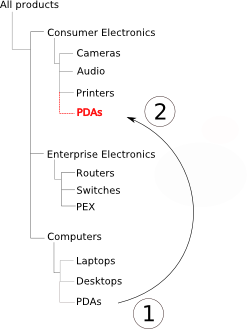
To understand how this change affects which readers can see articles classified with the PDAs category, review the following table.
When my role, permission set, or profile is mapped to: Could I see PDA articles in their old location under Computers? Can I see PDA articles in their new location under Consumer Electronics? Why? All products Yes Yes When your role, permission set, or profile is mapped to the top-level “All products” category, you can see everything in the category hierarchy. Computers Yes No You don't have access to the branch of the category hierarchy where PDAs is now located. Consumer Electronics No Yes PDAs has moved to the branch of the category hierarchy where you have been granted access. - How Changing the Hierarchy Affects Article Classification
- Classifying an article with a parent category implicitly grants access to that
category's children. You cannot explicitly apply both a parent category and one of
its children to an article. From the article edit page, selecting a parent
category grays out its child categories—you cannot select them in addition
to the parent category. Salesforce respects this fact when you move a category to
a new parent. It prevents explicitly adding a child category to an article when
the new parent category is already present.
In the example depicted above, the category PDAs moves from the original parent category Computers to the new parent category Consumer Electronics. As a result, the classification for each article can change.
- Articles formerly classified with both Consumer Electronics and PDAs lose PDAs, because having Consumer Electronics now implies having PDAs.
- Articles formerly classified with only Consumer Electronics but not PDAs do not change. Access to PDAs is now implied.
- Articles formerly classified with only PDAs, but not Consumer Electronics, retain PDAs.
Did this article solve your issue?
Let us know so we can improve!
