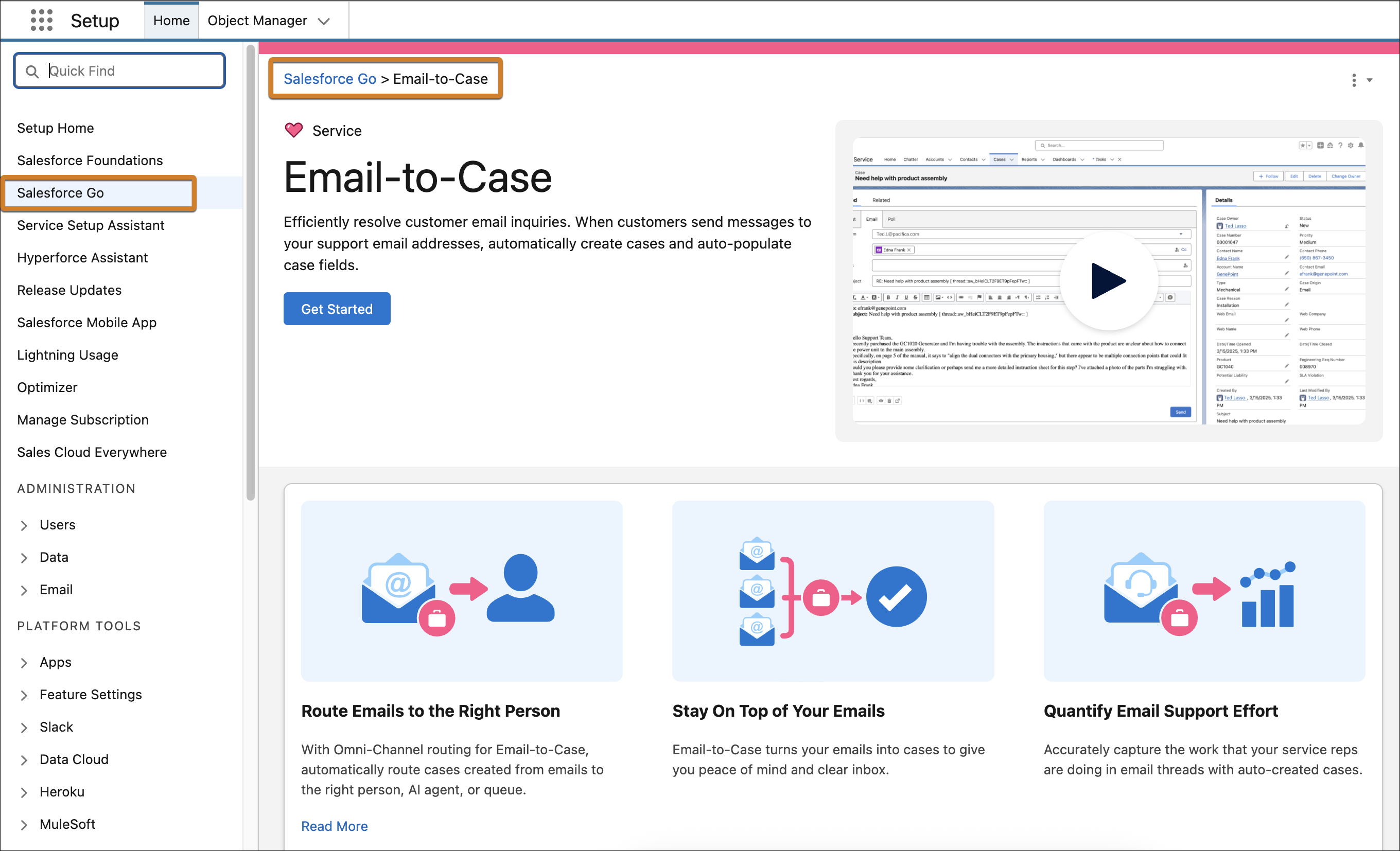
To quickly start using Email-to-Case, we recommend turning it on in Salesforce Go. When
you turn on Email-to-Case in Salesforce Go, these settings become active.
Required Editions
Salesforce Go is available in Lightning Experience
Available in: Pro Suite, Professional,Enterprise,
Unlimited, and Developer editions with Agentforce Service (formerly
Service Cloud)
Where To Find Salesforce Go
In Setup, click Salesforce
Go at the top of the Setup menu. Then, search for
Email-to-Case.
Default Settings
Email-to-Case interacts with other features, so it's important to understand its effects
when enabled.
Setting
What It Does
Considerations
Turn on Email-to-Case settings
Enables Email-to-Case and the following settings.
Notify case owners on new email
Enable HTML email
Set case source to email
Save Email-to-Case attachments as Salesforce files
Eliminate duplicate email attachments
Invoke triggers on status change from New to
Read
Reply with new content only
Insert email threading token in email subject
Place user signatures before email threads
Enable on-demand service
Use email headers for threading
After you turn on Email-to-Case, you can’t turn it off, but you can update its
settings.
Enable HTML email is required.
We recommend you leave on all
email threading settings for optimal security.
We recommend you leave on the
set case source to email setting to ensure that the Case Source field on newly
created cases is set to Email.
We use three kinds of cookies on our websites: required, functional, and advertising. You can choose whether functional and advertising cookies apply. Click on the different cookie categories to find out more about each category and to change the default settings.
Privacy Statement
Required Cookies
Always Active
Required cookies are necessary for basic website functionality. Some examples include: session cookies needed to transmit the website, authentication cookies, and security cookies.
Functional Cookies
Functional cookies enhance functions, performance, and services on the website. Some examples include: cookies used to analyze site traffic, cookies used for market research, and cookies used to display advertising that is not directed to a particular individual.
Advertising Cookies
Advertising cookies track activity across websites in order to understand a viewer’s interests, and direct them specific marketing. Some examples include: cookies used for remarketing, or interest-based advertising.