Add a menu of communication options to your website or Experience Builder site so
customers can choose how they contact you. For example, show a menu with four options: Chat,
WhatsApp, Text, and Call. Inquiries sent via the channel menu are routed to your support team
according to your routing preferences.
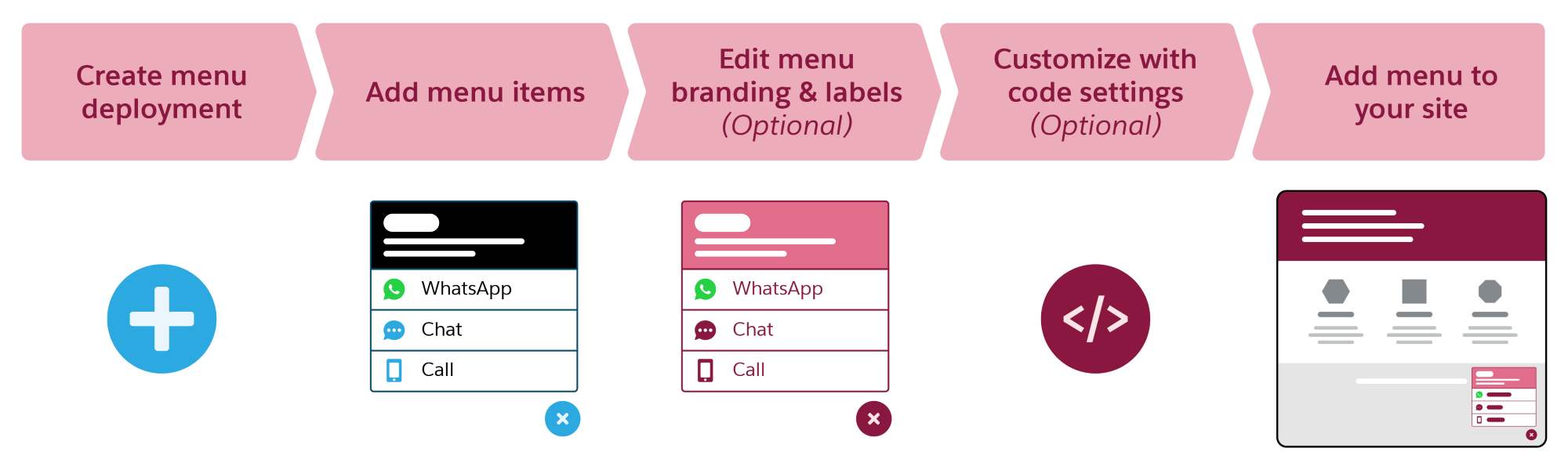
Create a Channel Menu Deployment To add a menu of contact channels to your website or Experience Cloud site, start by creating a channel menu deployment in Setup. After you create your menu deployment, you can add items to the menu and customize its branding.
Add Items to the Channel Menu Select and customize the customer channels that will appear in the channel menu on your Salesforce site or Experience Cloud site.
Set Branding for the Channel Menu After you create a channel menu for your Salesforce site or Experience Cloud site, customize the button colors, header background, and font to reflect your company’s brand.
Customize Labels and Translations for the Channel Menu Customize the text that appears in the channel menu on your website or Experience Cloud site. You can use the existing default labels or create custom labels for your menu header and channel names. Additional steps are required for translated labels.
Create Channel Menu Code Settings Add optional JavaScript code as a static resource to your channel menu to change the customer experience. Collect extra information in pre-chat or change the branding for your Enhanced Web Chat channel.
Sample Static Resource Files for Channel Menu Create JavaScript files to upload as static resources and apply them to your Channel Menu website or Experience site. This code sample populates pre-chat settings and adds a company logo.
Did this article solve your issue?
Let us know so we can improve!
Loading
Salesforce Help | Article
Cookie Consent Manager
General Information
Required Cookies
Functional Cookies
Advertising Cookies
General Information
We use three kinds of cookies on our websites: required, functional, and advertising. You can choose whether functional and advertising cookies apply. Click on the different cookie categories to find out more about each category and to change the default settings.
Privacy Statement
Required Cookies
Always Active
Required cookies are necessary for basic website functionality. Some examples include: session cookies needed to transmit the website, authentication cookies, and security cookies.
Functional Cookies
Functional cookies enhance functions, performance, and services on the website. Some examples include: cookies used to analyze site traffic, cookies used for market research, and cookies used to display advertising that is not directed to a particular individual.
Advertising Cookies
Advertising cookies track activity across websites in order to understand a viewer’s interests, and direct them specific marketing. Some examples include: cookies used for remarketing, or interest-based advertising.