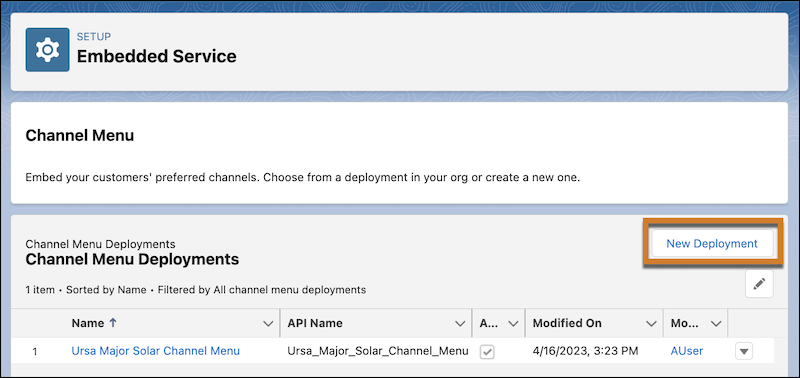
To add a menu of contact channels to your website or Experience Cloud site, start by
creating a channel menu deployment in Setup. After you create your menu deployment, you can add
items to the menu and customize its branding.
Required Editions
Important
Channel Menu code snippets created before August 8, 2025 use legacy infrastructure that’s
in maintenance mode and scheduled for retirement on July 1, 2026. If you’re using a code
snippet generated before August 8, 2025, we recommend updating it to avoid future
disruptions. Generate a new snippet from the Get Code section under the deployment
settings for your existing Channel Menu deployment and update your webpage. Learn more in
help.
To edit public access settings for Salesforce sites:
Manage Users
From Setup, enter Channel Menu in the Quick Find box and select
Channel Menu.
Click New Deployment.
Give the menu deployment a name that is easy to remember (spaces are OK). Customers
can’t see this name on your site.
Add your API name without spaces.
Set the site endpoint.
Enable guest access to the Support API for the site you use for the channel menu.
From Setup, enter Sites in the Quick Find box and select
Sites.
Click your site, then click Edit.
Select Guest Access to the Support API. Move the quick
actions associated with your deployment from Available Quick Actions to Selected Quick
Actions. Then, click Save.
Did this article solve your issue?
Let us know so we can improve!
Loading
Salesforce Help | Article
Cookie Consent Manager
General Information
Required Cookies
Functional Cookies
Advertising Cookies
General Information
We use three kinds of cookies on our websites: required, functional, and advertising. You can choose whether functional and advertising cookies apply. Click on the different cookie categories to find out more about each category and to change the default settings.
Privacy Statement
Required Cookies
Always Active
Required cookies are necessary for basic website functionality. Some examples include: session cookies needed to transmit the website, authentication cookies, and security cookies.
Functional Cookies
Functional cookies enhance functions, performance, and services on the website. Some examples include: cookies used to analyze site traffic, cookies used for market research, and cookies used to display advertising that is not directed to a particular individual.
Advertising Cookies
Advertising cookies track activity across websites in order to understand a viewer’s interests, and direct them specific marketing. Some examples include: cookies used for remarketing, or interest-based advertising.