(Optional) Set Up Customer-Initiated Scheduling for Prospect Customers in the Legacy
Agentforce Builder
By default, only authenticated customers can use Customer-Initiated Scheduling. You can configure guest user access to let prospect customers schedule appointments without needing a contact record.
Required Editions
Available in: Lightning Experience
Available in: Enterprise, Performance, Unlimited, and
Developer Editions with Field Service and Foundations, or Einstein 1 Field
Service Edition or Agentforce 1 Field Service Edition.
User Permissions Needed
To open, edit, or create a flow in Flow Builder:
Manage Flow
Enable guest users from the flow.
In Setup, find and select Flows.
Open the Field Service: Send Verification Code flow.
Click Save As New Flow.
Open the Toolbox.
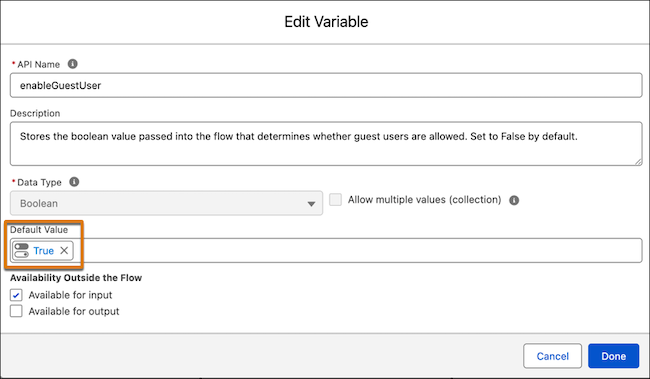
Open the enableGuestUser variable.
Change the default value from False to
True.
Click Done.
Save and activate the flow.
Add the subagent.
In Setup, find and select Agentforce Agents.
Open your agent.
Click Open in Builder.
If you already activated your agent, deactivate it to make changes.
From Subagents, click New and select Add from Asset
Library.
Select the Contact Creation for Field Service subagent and click
Finish.
Map the output variables to the context variables.
From Subagents, open the Contact Creation for Field Service
subagent.
Click This Subagent’s Actions.
Open the Create Contact for Field Service action.
In the Outputs section, map these variables:
Is Verified to
isCustomerVerified
Contact Id to
VerifiedCustomerId
Add the filter to the action.
In the Contact Creation for Field Service subagent, click the filter icon.
Note The guest user functionality is effected by the org's Standard Contact Matching Rule, which prevents creating
two contact records with the same first name and last name. If you want to allow this behavior,
modify the rule. See Standard Contact Duplicate Rule.
Did this article solve your issue?
Let us know so we can improve!
Loading
Salesforce Help | Article
Cookie Consent Manager
Cookie Consent Manager
General Information
Required Cookies
Functional Cookies
Advertising Cookies
General Information
We use three kinds of cookies on our websites: required, functional, and advertising. You can choose whether functional and advertising cookies apply. Click on the different cookie categories to find out more about each category and to change the default settings.
Privacy Statement
Required Cookies
Always Active
Required cookies are necessary for basic website functionality. Some examples include: session cookies needed to transmit the website, authentication cookies, and security cookies.
Functional Cookies
Functional cookies enhance functions, performance, and services on the website. Some examples include: cookies used to analyze site traffic, cookies used for market research, and cookies used to display advertising that is not directed to a particular individual.
Advertising Cookies
Advertising cookies track activity across websites in order to understand a viewer’s interests, and direct them specific marketing. Some examples include: cookies used for remarketing, or interest-based advertising.