
Define Which Appointments Can Be Scheduled During Shifts
Similar to how you use designated time slots on operating hours, in Field Service,
you can use Record set Filter Criteria to define and designate which appointments can be
scheduled to service resources during shifts. Create Recordset Filter Criteria based on
service appointment field values, and then add the filter to a shift so that only relevant
appointments get scheduled.
Required Editions
Available in: Lightning Experience
The Field Service core features, managed package, and mobile app are available in
Enterprise, Unlimited, and Developer Editions.
User
Permissions Needed
To view, create, and update recordset filter criteria
View, create, and edit on Service Appointments, Shifts, Recordset
Filter Criteria, and Recordset Filter Criteria
Rules
AND
Delete on Recordset Filter Criteria
Rules
In the App Launcher, click Recordset Filter
Criteria.
In the Recordset Filter Criteria list view, click
New.
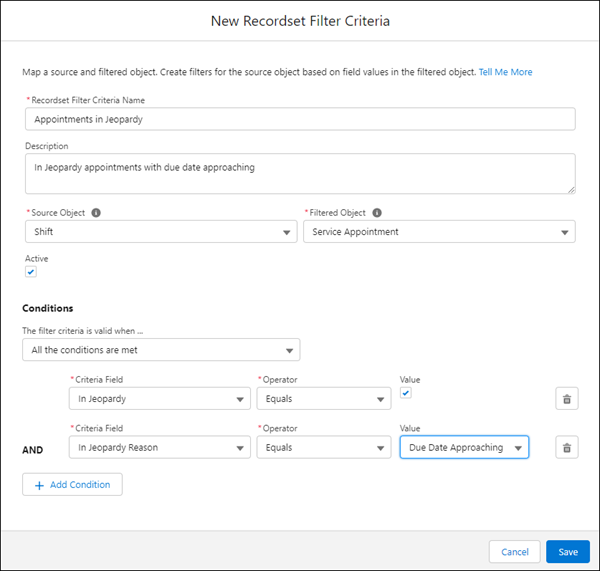
Enter a name and description for the criteria.
In the Source Object field, select Shift.
In the Filtered Object field, select Service
Appointment.
Select Active.
In the Conditions section, select the relevant condition for when the recordset
filter criteria is valid.
Add filter conditions.
Select the Criteria Field, the Operator, and the field Value to match
on. The Value input changes depending on the field you select. For
example, picklist fields show the list of available choices.
Add another condition if you must.
Save the recordset filter criteria.
Assign your new record set filter criteria record to a shift record to make
sure the scheduling and optimization engine only allows service appointments
that meet the criteria to be assigned during the shift time-frame.
Guidelines for Recordset Filter Criteria Field Service filter criteria let you match records in one object against records in another. For example, you can choose criteria to filter which service appointments can be scheduled during a shift.
We use three kinds of cookies on our websites: required, functional, and advertising. You can choose whether functional and advertising cookies apply. Click on the different cookie categories to find out more about each category and to change the default settings.
Privacy Statement
Required Cookies
Always Active
Required cookies are necessary for basic website functionality. Some examples include: session cookies needed to transmit the website, authentication cookies, and security cookies.
Functional Cookies
Functional cookies enhance functions, performance, and services on the website. Some examples include: cookies used to analyze site traffic, cookies used for market research, and cookies used to display advertising that is not directed to a particular individual.
Advertising Cookies
Advertising cookies track activity across websites in order to understand a viewer’s interests, and direct them specific marketing. Some examples include: cookies used for remarketing, or interest-based advertising.
