Customer Service Incident Management provides a series of sample flows that you can
customize and activate to streamline your incident resolution process.
To cut down on repeat tasks when an incident is resolved, automatically close a change request
and its related issues, like cases, problems, and incidents.
For example, when a support rep is ready to mark a change request as complete, the support
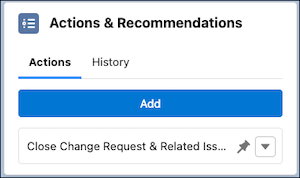
rep can use the Close Change Request & Related Issues flow from the Actions &
Recommendation component on the change request.
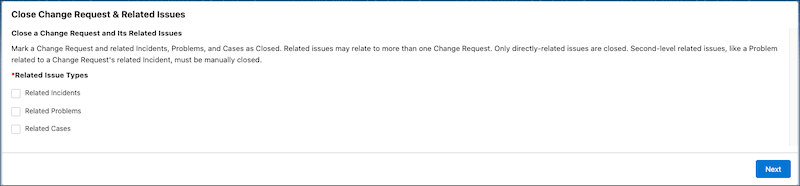
After they launch the flow, a screen appears that asks them to select which related issues to
close.
Change Case Owner to Incident Owner
When cases are identified as part of an overarching incident and to avoid duplicative work,
automatically change the case owner to the incident owner.
For example, a support rep sees an influx of cases coming in that are marked as related to
an ongoing incident, but notices that the case owner and incident owner aren’t the same. The
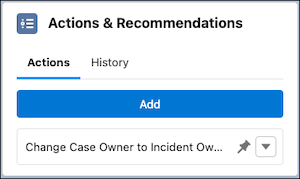
support rep can use the Change Case Owner to Incident Owner flow from the Actions &
Recommendations component on the incident.
After they launch the flow, a screen appears to confirm that they want to change the owner of
the cases to the incident owner.
Did this article solve your issue?
Let us know so we can improve!
Loading
Salesforce Help | Article
Cookie Consent Manager
General Information
Required Cookies
Functional Cookies
Advertising Cookies
General Information
We use three kinds of cookies on our websites: required, functional, and advertising. You can choose whether functional and advertising cookies apply. Click on the different cookie categories to find out more about each category and to change the default settings.
Privacy Statement
Required Cookies
Always Active
Required cookies are necessary for basic website functionality. Some examples include: session cookies needed to transmit the website, authentication cookies, and security cookies.
Functional Cookies
Functional cookies enhance functions, performance, and services on the website. Some examples include: cookies used to analyze site traffic, cookies used for market research, and cookies used to display advertising that is not directed to a particular individual.
Advertising Cookies
Advertising cookies track activity across websites in order to understand a viewer’s interests, and direct them specific marketing. Some examples include: cookies used for remarketing, or interest-based advertising.