
You are here:
Migrate a Single Article Type
You planned your migration. You went over the pre-migration checklist, and you made all the prerequisite revisions to your Classic knowledge base. You’re aware of the limitations. You’re ready to go. Here’s your step-by-step guide to using the Lightning Knowledge Migration Tool in orgs with a single article type.
Required Editions
| Available in Lightning Experience. View supported editions. |
| User Permissions Needed | |
|---|---|
| To use the Lightning Knowledge Migration Tool: | Customize Application AND Knowledge User AND Manage Knowledge |


- Switch to Lightning Experience.
- From Setup, enter lightning knowledge in the Quick Find box, then select Lightning Knowledge Migration Tool.
- Follow the on-screen instructions and start the migration.
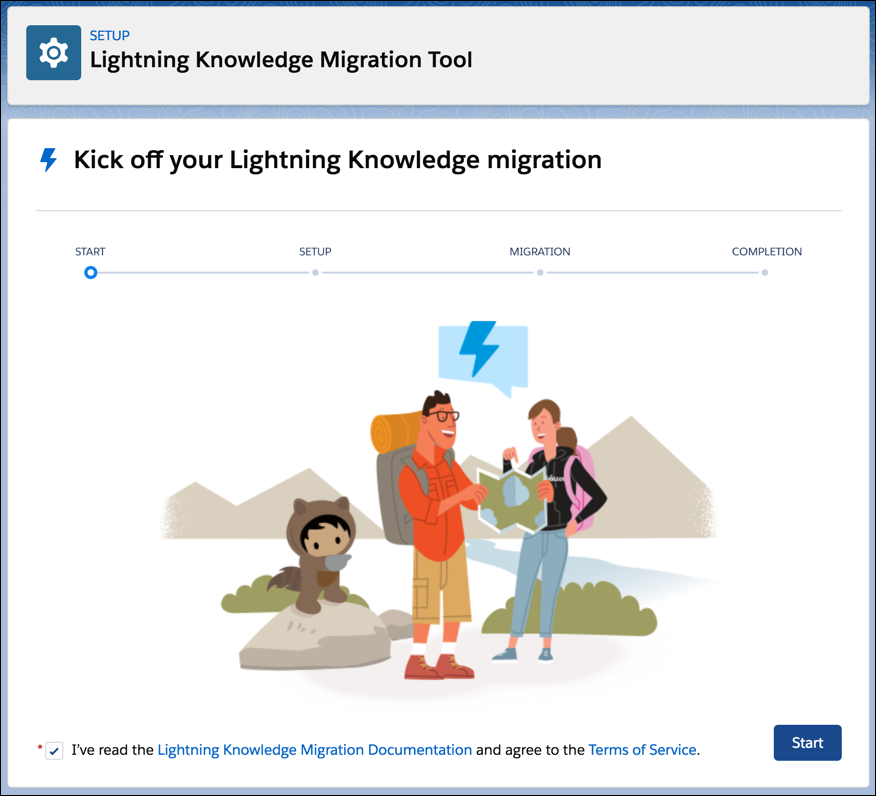 Note If you receive an error message after beginning the migration, follow the instructions in the message, and then restart the migration.
 - Choose whether to create a record type during migration.
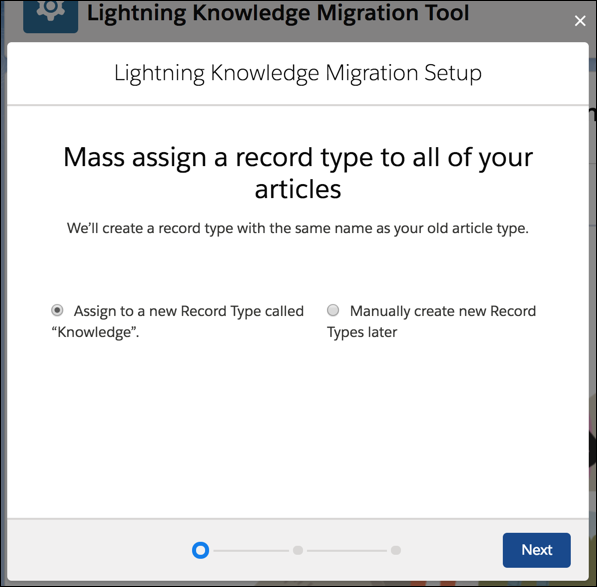
- Begin migration. Follow the on-screen instructions. Completion time depends on the size of
your knowledge base and how many other processes are running at the same time.
 Important You can’t undo the migration or disable Lightning Knowledge after you start the migration. After you migrate, the Lightning Knowledge Migration Tool is no longer available in Setup.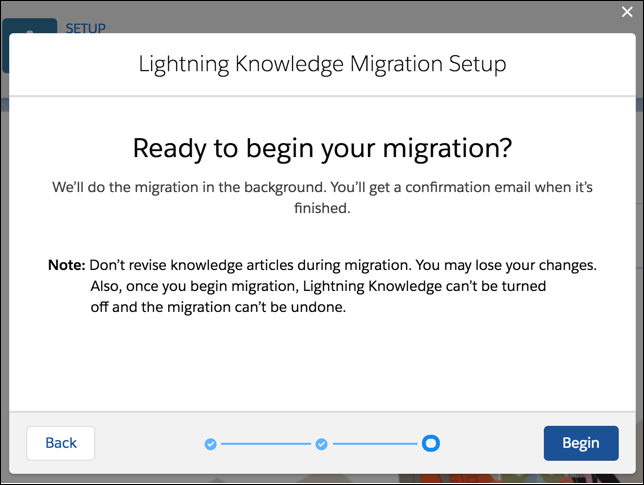
- (Optional) If your migration includes files, you see a screen during migration to set the
default visibility. To provide your Experience Cloud site users, such as customers,
partners, and guest users, access to files, select All users. File
visibility is always restricted to users who can access the record where it is attached. You
can change the visibility for individual files after migration.Note If your migration includes files, you receive a confirmation email when the migration is complete, and a report is created to show the outcome of the file migration. All users with administrative permission and the Modify All Data permission receive the confirmation email.
Look for the report file named LightningKnowledgeMigrationResultTimestamp.txt in the standard Files tab. The admin who started the migration owns the report file. If everything migrated, the report shows a success message. The report also lists articles with files that failed to migrate.
- Proceed to the Lightning Knowledge Post-Migration Checklist.
