
Choose the Sharing or Access Model for Lightning Knowledge
The standard Salesforce sharing model contrasts with the default for Knowledge, which
uses data categories to control access beyond object permissions. When you use standard sharing,
data categories no longer control record access. Your knowledge base continues to use data
categories to classify articles. Data categories affect searches and queries and can be used as
filters.
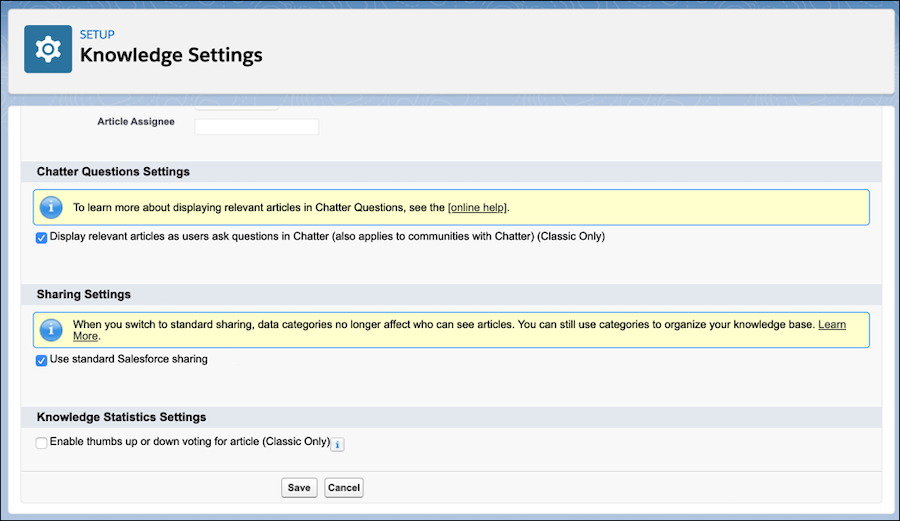
To use the Salesforce sharing model for Knowledge:
From Setup, enter knowledge in the quick find box and select
Knowledge Settings.
Click Edit.
Under Sharing Settings, select Use standard Salesforce
sharing.
Save your changes.
To view the sharing settings for Knowledge, from Setup, enter
sharing in the quick find box and select Sharing
Settings. By default, the knowledge object uses Public Read/Write for
internal users and Private for external access.
To add a sharing rule, click New under Knowledge Sharing
Rules.
You can switch from Salesforce sharing back to data category sharing by deselecting
Use standard Salesforce sharing in the Knowledge Settings page. We
recommend that you delete all sharing rules for knowledge articles before you switch back to
data category sharing. Before you can turn off standard sharing, make sure that the
organization-wide default access for internal and external users is Public Read/Write. Wait
for any sharing recalculations to finish because you can’t change the sharing model while
calculations are in progress.
We use three kinds of cookies on our websites: required, functional, and advertising. You can choose whether functional and advertising cookies apply. Click on the different cookie categories to find out more about each category and to change the default settings.
Privacy Statement
Required Cookies
Always Active
Required cookies are necessary for basic website functionality. Some examples include: session cookies needed to transmit the website, authentication cookies, and security cookies.
Functional Cookies
Functional cookies enhance functions, performance, and services on the website. Some examples include: cookies used to analyze site traffic, cookies used for market research, and cookies used to display advertising that is not directed to a particular individual.
Advertising Cookies
Advertising cookies track activity across websites in order to understand a viewer’s interests, and direct them specific marketing. Some examples include: cookies used for remarketing, or interest-based advertising.