
You are here:
Create and Send Questions with Dynamic Options in Messaging Sessions
To quickly locate the record that a customer is inquiring about, let service reps send customers a question with a dynamic list of records to choose from. For example, ask customers to choose from a list of their recent orders or cases. Create your question and options in Setup, and then add a flow that service reps run to send the question to customers in a messaging session.
Required Editions
| View supported editions. | |
 This article applies to:
|
Enhanced In-App Chat, Enhanced Web Chat v1, Enhanced Web Chat v2, Enhanced WhatsApp, Enhanced Facebook Messenger, Enhanced Apple Messages for Business, Enhanced LINE, and Bring Your Own Channel |
 This article doesn’t apply to:
|
Standard Facebook Messenger, and Standard and Enhanced SMS channels |
| User Permissions Needed | |
|---|---|
| To create messaging components: | Customize Application AND View Setup and Configuration OR System Administrator |
| To send and receive messages in Messaging: | Messaging Agent |
- From Setup, in the Quick Find box, enter Messaging Components, and then select Messaging Components.
- Click New Component, and then click Next.
- Click Question with Options, and then select Dynamic Options.
- Enter your question. For example, Where are you located? If you plan to use your component in enhanced WhatsApp channels, keep your question under 20 characters and your options under 24 characters.
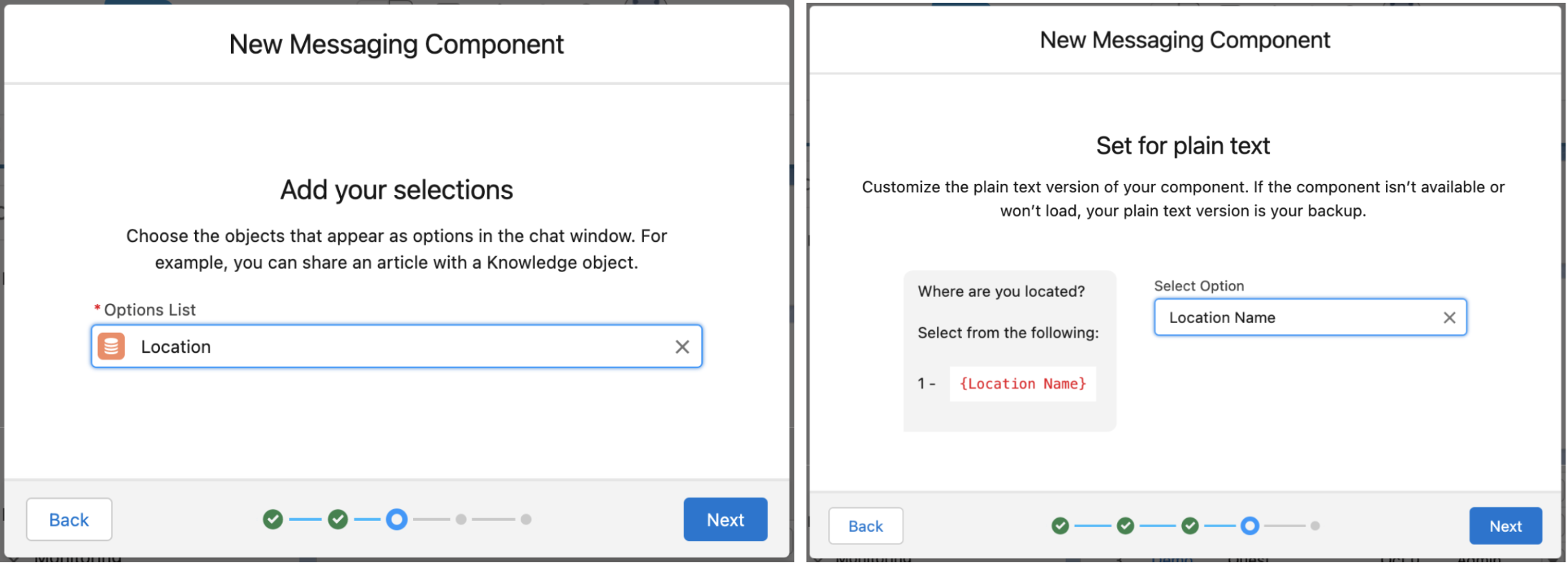
- Select an object. Only Case, Product, Asset, Order, and custom objects can be selected.
-
From the list of object fields, select the plain text display field. For example, if you’re
working with a custom Location object, select the Location Name field to show a list of
location names.
-
Enter a name and description for your question.
These values aren’t visible to customers, but service reps see the name in the Service Console.
-
Click Done.
The Messaging Component Builder opens.
-
On the Component Details page, further customize your component.
-
In the Component Formats section, control the way your component appears in each type of
Messaging channel. Click Add Format, select a format, and then click
Done.
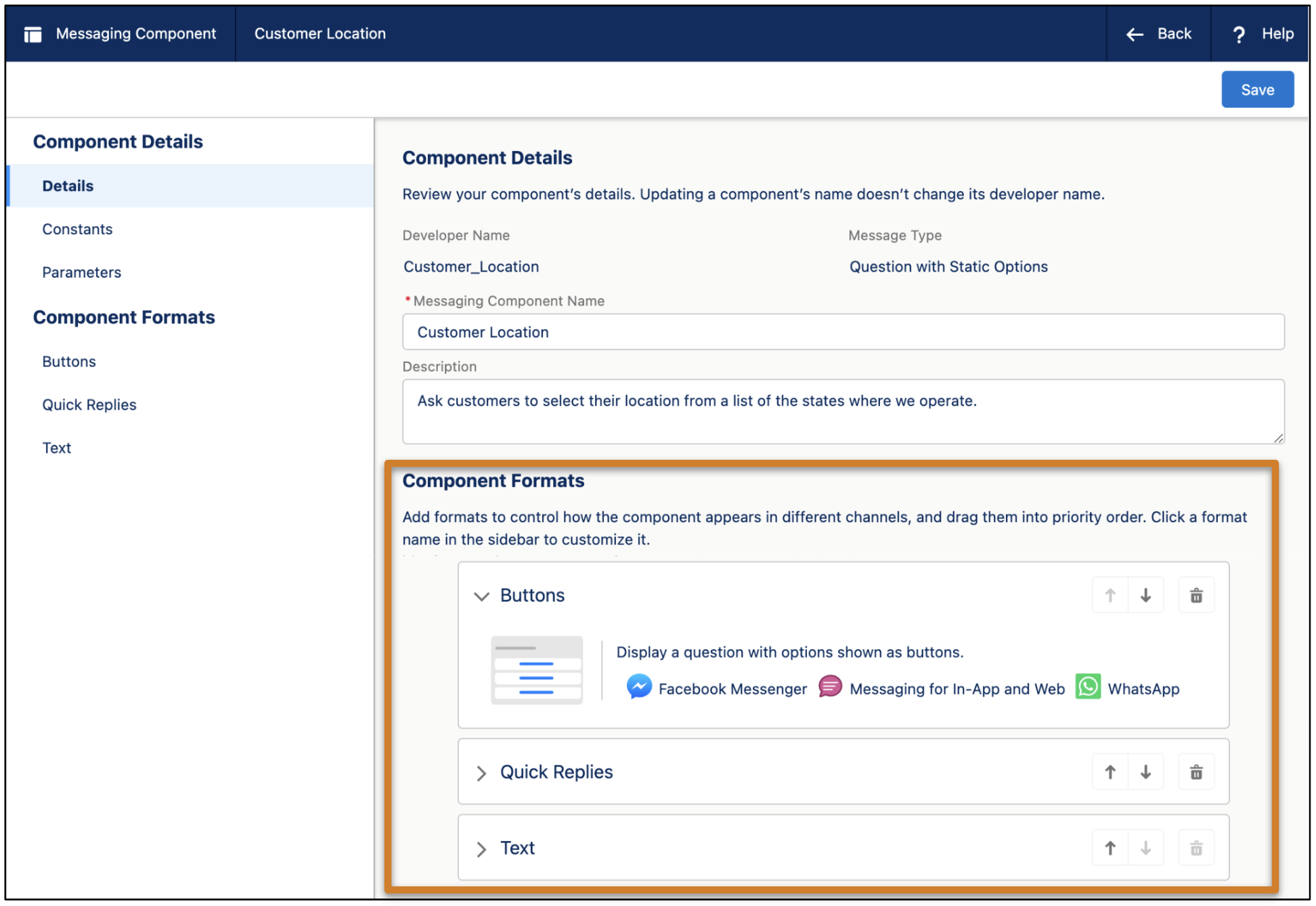
 Note Each messaging component is available in one or more formats, such as Buttons, and some formats work only in certain channels. For a list of formats that each channel supports, see Messaging Component Types and Formats. It’s a good idea to add at least one supported format for each channel where the component will be sent. If no formats are added, the component uses the default text format.
 - In the left-hand sidebar, click a format type to customize its properties.
- In the Component Properties pane, configure each format’s properties. To keep it simple, use the auto-created constant for the question and the auto-created parameter to show records by field value, such as Location Name. Then, click Save.
- Arrange the formats you selected in priority order. If a component can’t be shown in the highest-priority format, the next format is used.
-
In the Component Formats section, control the way your component appears in each type of
Messaging channel. Click Add Format, select a format, and then click
Done.
- Your component is saved in a draft state. When you're ready to make it available to your support team, click Activate at the top of the page.
-
When you’re done editing your component, click Save.
If you ever need to take the component offline—for example, to give you time to reconfigure it—open it in the Messaging Component Builder and click Deactivate. When you're ready, activate it again.
After you create your component, it’s time to link it to a flow that service reps can use to send it to a customer. Then, add the flow to the Service Console and test it.
- Set Up a Flow to Send Questions with Options in Messaging Sessions
To let service reps send a question with dynamic options in supported enhanced Messaging channels or Enhanced Chat, create a flow and associate it with your question component. Then, add the flow to the Service Console.
Did this article solve your issue?
Let us know so we can improve!
