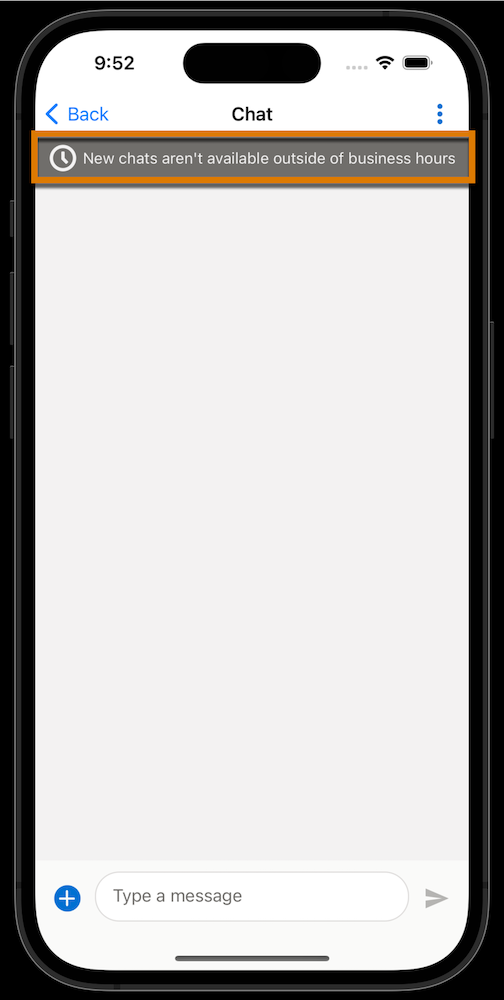
Don’t leave your customers waiting. Prevent customers from starting new messaging
sessions outside of your business hours. After setting business hours, the Enhanced Web Chat
button disappears when you’re not working, and Enhanced In-App Chat customers see a banner
letting them know that your business hours are over. Use the API to prevent incoming
Enhanced In-App Chat conversations outside of business hours.
Enhanced In-App Chat and Enhanced Web Chat channels
This article doesn’t apply to:
Enhanced WhatsApp, Standard and Enhanced Facebook Messenger, Standard and
Enhanced SMS, Enhanced Apple Messages for Business, Enhanced LINE, and Bring Your Own
Channel
User Permissions Needed
To create business hours:
Manage Business Hours Holidays
To add business hours to your deployment:
Customize Application AND Modify Metadata Through Metadata API Functions
From Setup, enter Embedded Service Deployments, and click
Embedded Service Deployments.
Click the dropdown arrow to the right of your deployment, and select
View.
Click Edit Settings.
In the Business Hours field, select your business hours record.
Save your changes.
On the Settings page for your deployment, click Publish.
After adding business hours to your Enhanced Web Chat deployment, the chat button appears
only during your business hours. Outside of business hours, Enhanced In-App Chat
displays a banner that lets the customer know when it’s outside of business
hours.
To prevent incoming conversations outside of business hours, override business hours rules,
or hide or show your chat button at different times, see Show and Hide the Chat Button in Enhanced Web
Chat.
We use three kinds of cookies on our websites: required, functional, and advertising. You can choose whether functional and advertising cookies apply. Click on the different cookie categories to find out more about each category and to change the default settings.
Privacy Statement
Required Cookies
Always Active
Required cookies are necessary for basic website functionality. Some examples include: session cookies needed to transmit the website, authentication cookies, and security cookies.
Functional Cookies
Functional cookies enhance functions, performance, and services on the website. Some examples include: cookies used to analyze site traffic, cookies used for market research, and cookies used to display advertising that is not directed to a particular individual.
Advertising Cookies
Advertising cookies track activity across websites in order to understand a viewer’s interests, and direct them specific marketing. Some examples include: cookies used for remarketing, or interest-based advertising.