Map Your Salesforce Queues to Telephony Provider Queues
To route calls to a contact center queue, map the Salesforce queue to the telephony
provider queue. Although you can define the routing logic using Salesforce queues, the routing
actually takes place in the telephony system using the telephony provider queues. To ensure that
calls are routed correctly, map the queues. Calls assigned to an unmapped queue aren’t routed at
runtime.
Required Editions
This article applies to:
Salesforce Voice with Amazon Connect
Salesforce Voice with Partner Telephony
Salesforce Voice with Partner Telephony from Amazon Connect
To map telephony provider queues to Salesforce queues:
Customize Application or Salesforce Voice Contact Center Admin
If you haven’t already done so, create queues in Salesforce and in your telephony system
before proceeding with this step.
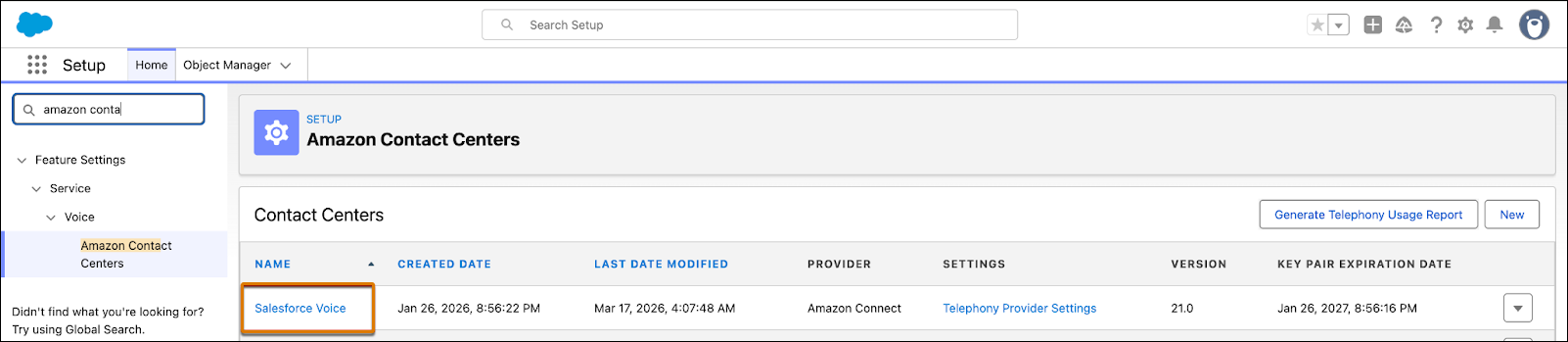
In Setup, enter Contact Centers in the Quick Find box, then select
Amazon Contact Centers or Partner Telephony Contact
Centers, depending on your telephony provider.
Click the contact center name for which you want to map queues.
Under Queue Mapping, click Add.
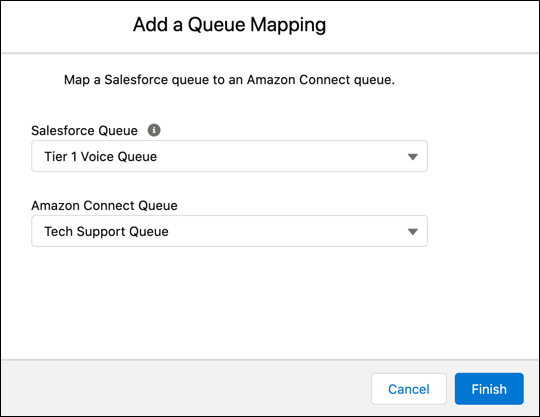
Map the Salesforce queue to the telephony provider’s queue.
The Salesforce Queue dropdown shows queues that support the VoiceCall object, use a
routing configuration with the external routing model, and aren’t already mapped. Each
Salesforce queue can be mapped to one external queue.
Click Finish.
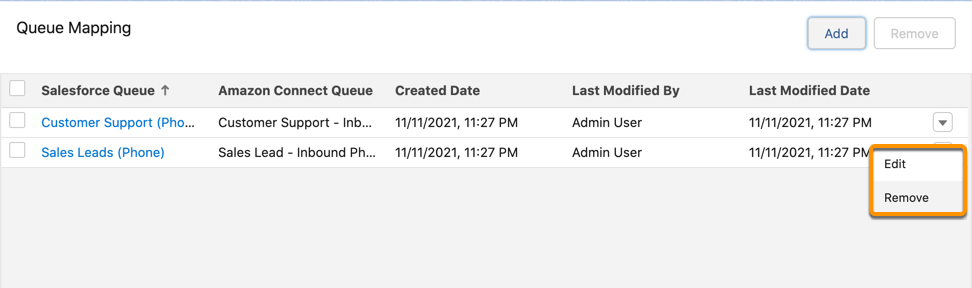
The mapping appears under the Queue Mapping section in the contact center details
page. To edit or delete a mapping, click the dropdown to the right of the queue mapping and
select Edit or Delete.
We use three kinds of cookies on our websites: required, functional, and advertising. You can choose whether functional and advertising cookies apply. Click on the different cookie categories to find out more about each category and to change the default settings.
Privacy Statement
Required Cookies
Always Active
Required cookies are necessary for basic website functionality. Some examples include: session cookies needed to transmit the website, authentication cookies, and security cookies.
Functional Cookies
Functional cookies enhance functions, performance, and services on the website. Some examples include: cookies used to analyze site traffic, cookies used for market research, and cookies used to display advertising that is not directed to a particular individual.
Advertising Cookies
Advertising cookies track activity across websites in order to understand a viewer’s interests, and direct them specific marketing. Some examples include: cookies used for remarketing, or interest-based advertising.