Knowledge Article Summary, an Einstein for Service feature, uses generative AI to
provide a concise, clear overview of a knowledge article's content. This feature automatically
generates and shows the summary on the article's detail page, helping you quickly understand the
core content of the article.
Required Editions
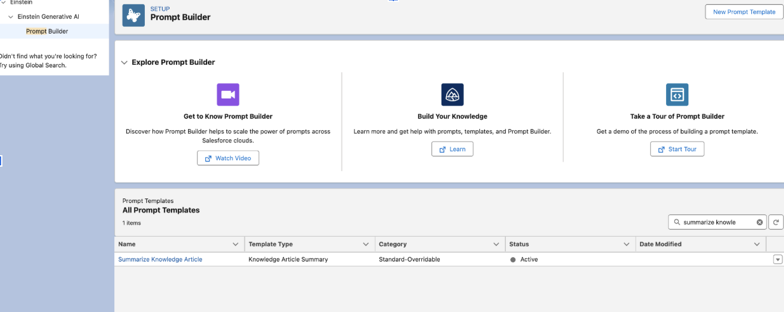
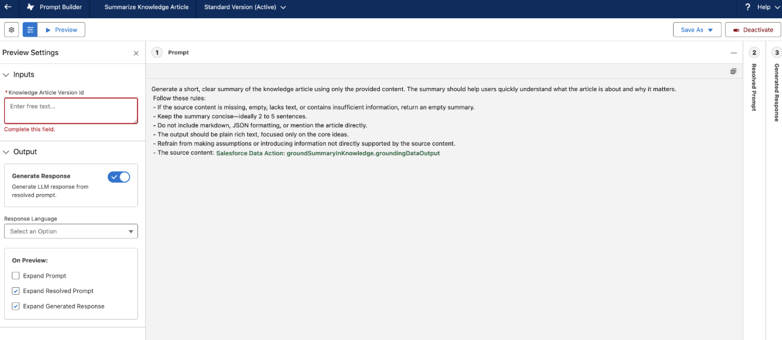
Knowledge Article Summary uses the standard Summarize Knowledge Article prompt template to
generate summaries. With the correct permissions, you can modify this template in the Prompt
Builder to fine-tune the output, including the tone, style, length, AI model, and other
variables.
Available in: Salesforce Classic and Lightning Experience
Available in: Enterprise, Performance, and Unlimited Editions
Available in: Community, Community Plus, or Agentforce for Service
add-on
Set Up Article Summary in Experience Builder Add the Knowledge Article Summary Lightning web component to the Knowledge or Article Detail page in Experience Builder and publish the site to display the AI-generated summaries on your public-facing site. This component is compatible with both Aura and LWR sites.
Knowledge Article Summary Limitations and Important Considerations This topic describes the known limitations and important considerations for the Knowledge Article Summary feature. Awareness of these limitations supports proper component behavior and improves the quality of AI-generated summaries.
We use three kinds of cookies on our websites: required, functional, and advertising. You can choose whether functional and advertising cookies apply. Click on the different cookie categories to find out more about each category and to change the default settings.
Privacy Statement
Required Cookies
Always Active
Required cookies are necessary for basic website functionality. Some examples include: session cookies needed to transmit the website, authentication cookies, and security cookies.
Functional Cookies
Functional cookies enhance functions, performance, and services on the website. Some examples include: cookies used to analyze site traffic, cookies used for market research, and cookies used to display advertising that is not directed to a particular individual.
Advertising Cookies
Advertising cookies track activity across websites in order to understand a viewer’s interests, and direct them specific marketing. Some examples include: cookies used for remarketing, or interest-based advertising.