After you set up a partner contact center with Messaging channel support for Bring Your
Own Channel for CCaaS, you can add a Salesforce Voice channel to the contact
center.
Salesforce Voice Contact Center Admin (Partner Telephony)
To enable Voice in a partner contact center that already has Messaging support, you
must have a Service Cloud User license, a Salesforce Voice Partner Telephony add-on
license, and a Digital Engagement add-on license.
Before you begin, install a managed
package from a CCaaS provider to support Bring Your Own Channel for CCaaS and Service Cloud
Voice.
From Setup, enter Partner Telephony Contact Centers in the Quick
Find box, and then select Partner Telephony Contact Centers.
Click New.
Select your CCaaS provider and select Next.
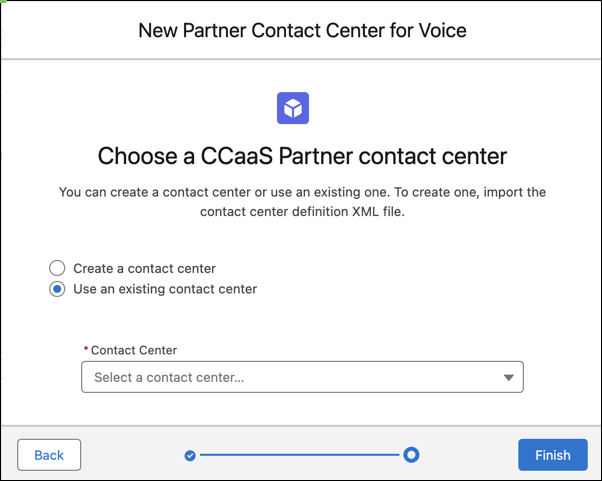
Select Use an existing Contact Center.
Select the messaging-only partner contact center to which you want to add Service Cloud
Voice.
The contact center now supports partner telephony as well as Bring Your Own Channel
for CCaaS Messaging channels.
You can now create a phone channel in this contact center. To support multiple phone numbers
in the same contact center, create additional voice channels.
We use three kinds of cookies on our websites: required, functional, and advertising. You can choose whether functional and advertising cookies apply. Click on the different cookie categories to find out more about each category and to change the default settings.
Privacy Statement
Required Cookies
Always Active
Required cookies are necessary for basic website functionality. Some examples include: session cookies needed to transmit the website, authentication cookies, and security cookies.
Functional Cookies
Functional cookies enhance functions, performance, and services on the website. Some examples include: cookies used to analyze site traffic, cookies used for market research, and cookies used to display advertising that is not directed to a particular individual.
Advertising Cookies
Advertising cookies track activity across websites in order to understand a viewer’s interests, and direct them specific marketing. Some examples include: cookies used for remarketing, or interest-based advertising.